Car tariffs are here, prices are rising, and millions of Americans are asking: “Should I buy now or wait?” If you’re on a budget or low income, the decision is even more critical. Here’s exactly what tariffs mean for your wallet — and the best strategy for buying a car in 2026.
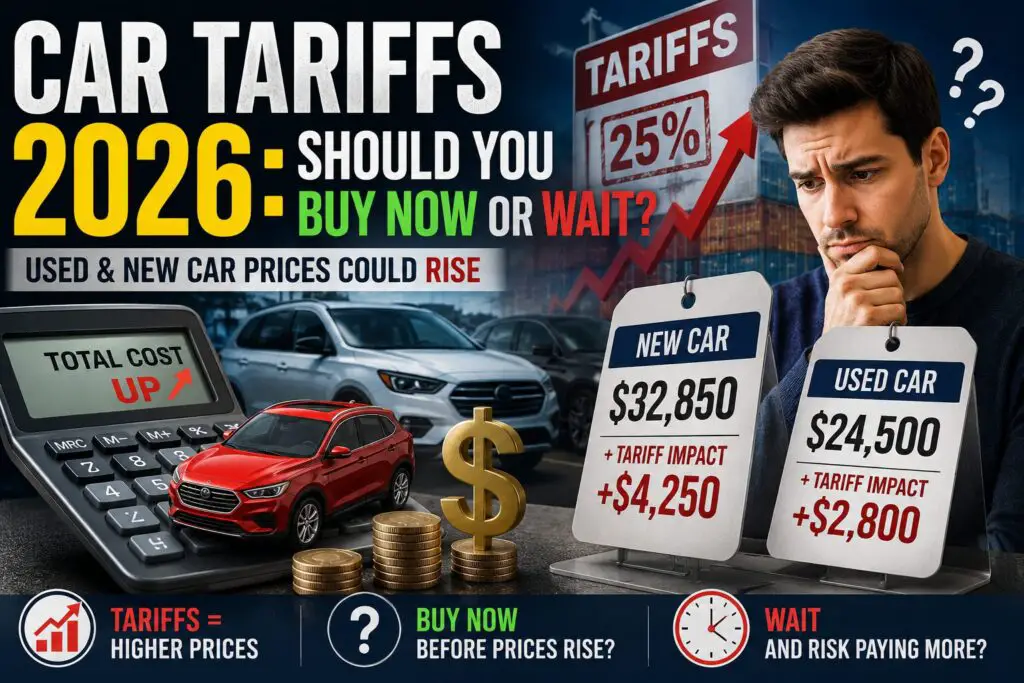
⚡ Quick AnswerA 25% tariff on imported vehicles took effect April 3, 2026. New car prices jumped $1,315 on average in Q1 2026, and could rise $4,000–$6,000 more through 2026. Used car prices are also climbing due to increased demand. For budget buyers: buying used NOW is better than waiting for new cars to drop. Used cars have more room for negotiation. Combined with government car assistance programs (DCAP, VXC, car vouchers), low-income families can still find deals — but they need to act before used car inventory tightens further.
What Are the Car Tariffs?
In April 2026, the Trump administration imposed a 25% tariff on imported passenger vehicles and light trucks. In May 2026, a 25% tariff on imported auto parts also went into effect.
Here’s what that means in dollar terms:
- Imported car worth $40,000: Add $10,000 in tariff costs
- Imported car worth $30,000: Add $7,500 in tariff costs
- Imported car worth $50,000: Add $12,500 in tariff costs
The auto parts tariff affects even US-assembled vehicles because most cars are built with imported components. Toyota, Honda, BMW, Volkswagen, Hyundai, Kia, Mercedes, Audi — all face tariff costs. Even American-brand vehicles (Ford, Chevy, Dodge) often contain imported parts or are partially assembled overseas.
About 50% of new cars sold in America are imported or contain significant imported components. That means tariffs affect roughly HALF of the new car market — not just foreign brands.
How Much Have Prices Actually Risen?
Data from Q1 2026 shows new car prices jumped an average of $1,315 compared to Q1 2026. But tariff impacts are still rolling through the supply chain. Here’s the timeline:
| Time Period | What Happened | Price Impact |
|---|---|---|
| Before April 3, 2026 | No tariffs; cars on lots are tariff-free | Baseline prices (2024-early 2026 levels) |
| April 3 — Aug 31, 2026 | Tariffs begin; manufacturers absorb some costs in margins; supply chain lag | Modest increases ($500–$2,000) |
| Sept 2026 — April 2026 | Tariff-affected vehicles increasing on dealer lots; parts tariff hits harder | Average $1,315+ increase (Q1 2026 data) |
| May 2026 onward | Most “old stock” gone; tariff-affected inventory dominant; manufacturers may raise MSRPs further | Potentially $3,000–$6,000+ more than 2024 baseline |
On top of tariff impacts, destination fees (shipping costs from factory to dealer) have surged 25% for domestic brands ($2,189 average). Imports average $1,476. These fees are set by manufacturers and are separate from tariff costs.
New Cars vs Used Cars — Which Should You Buy?
| Factor | NEW Cars | USED Cars |
|---|---|---|
| Tariff Impact | Very high — still being absorbed/passed on | Indirect — rising prices due to demand shift |
| Price Trend 2026 | Likely UP another $2,000–$6,000 before end of year | Stable to slightly UP, but has negotiation room |
| Inventory | Becoming scarce (pre-tariff inventory sold out) | Still available but tightening fast |
| Best for Budget Buyers | Wait if possible; prices not bottoming out yet | BUY NOW before used inventory shrinks |
| Negotiation Power | Low — dealers holding firm on tariff-raised prices | Moderate to High — still room to negotiate |
| Warranty/Reliability | Full manufacturer warranty | Varies; no factory warranty unless CPO |
Buy used NOW rather than new later. Used car inventory is tightening as budget buyers flee high new-car prices. By Q4 2026, good used cars in the $10K–$20K range may be sold out or priced significantly higher. A good used car TODAY is likely a better deal than waiting for new car prices to drop (which economists don’t expect).
Which Cars Are MOST Affected by Tariffs?
Electric vehicles are among the hardest hit — for a model-by-model breakdown and a price calculator, see our 2026 EV Tariffs guide.
The tariffs hit hardest on vehicles with the most imported content or those assembled overseas. Here’s the breakdown:
| MOST Affected (Full 25% Hit) | Partially Affected (Lower Hit) | LEAST Affected |
|---|---|---|
| Toyota (Japan) | Tesla (US-made but imported parts) | Some Ford trucks (domestic parts heavy) |
| Honda (Japan) | Chevy (mix of domestic/imported) | RAM trucks (domestic assembly) |
| Nissan (Japan) | Volkswagen/Audi (some US plants) | Dodge (domestic-heavy) |
| BMW/Mercedes (Germany/Europe) | Jeep (mixed sourcing) | Some Chevy Silverado (domestic) |
| Hyundai/Kia (Korea) | Mazda (some US assembly) | Domestic-only suppliers rare |
| Volvo (Sweden) | Subaru (US plant + imports) | Note: Almost all cars have imported parts |
The cheapest used cars are often older Japanese imports (Honda Civic, Toyota Corolla, Nissan Altima). These models have strong resale value because they’re reliable — tariffs won’t change that. Your best budget bet: look for 2015–2018 Toyota/Honda models with 80K–120K miles. They’re durable, cheap to maintain, and less affected by tariff price inflation than newer models.
Should You Buy Now or Wait?
If You’re Buying a NEW Car:
Wait — prices will likely keep rising through 2026.
- Manufacturers are still absorbing tariff costs in margins (reduces profits but keeps prices “lower”)
- Once margin absorption hits limits (Q3-Q4 2026), MSRP increases will accelerate
- Economists don’t expect new car prices to drop; they expect them to stabilize at a higher level
- Waiting for prices to drop is a losing bet — instead, focus on negotiation power and incentives (see below)
If You’re Buying a USED Car:
Buy NOW — inventory is tightening fast.
- Used car demand spiked as budget buyers avoided expensive new cars
- Good used cars in the $10K–$25K range are selling quickly
- Dealers know used cars are hot — they’re not negotiating much on price, but you still have leverage
- By August 2026, selection will be worse and prices higher
Tariffs are forcing budget car buyers into a tight spot. New cars are too expensive. Used car prices are rising. Solution: Combine used car buying with government assistance programs. DCAP (California), VXC (Colorado), state car vouchers, and TANF programs can bridge the gap. See Section 7 below.
Strategy for Budget Buyers: 6-Step Action Plan
- Don’t buy new unless you must. New car tariff impacts are still unfolding. Unless you need a specific new vehicle (EV for rebate, etc.), used is smarter in 2026.
- Act on used cars NOW. Every month, inventory shrinks. Check local dealer inventory TODAY and test drive cars that fit your budget before they’re gone.
- Check which cars hold value best. Toyota, Honda, Mazda, Nissan. These depreciate slower and resell easier. Avoid trendy brands that lose value fast.
- Negotiate aggressively on used cars. Dealers know used cars are hot, but you still have leverage. Offer 5-10% below asking, get a pre-purchase inspection ($150–$300, worth it), ask about warranties.
- Explore government car assistance programs. If you’re low-income: Check DCAP (California), VXC (Colorado), state car vouchers, TANF car repair help. These can reduce your out-of-pocket cost significantly.
- Time your purchase for mid-month or end-of-quarter. Dealers have monthly/quarterly quotas. Buying on the 20th or at quarter-end gives you more negotiation power. Avoid peak car-buying season (holidays, end of model year).
Low-Income Buyers: Combine Used Cars with Government Programs
The tariff shock is hitting low-income families hard. But you have options. Government car assistance programs can help bridge the gap.
| Program | Location | Max Assistance | Works with Used Cars? |
|---|---|---|---|
| DCAP (Driving Clean) | California | $12,000 grant for EV | Yes — used EVs eligible |
| VXC (Vehicle Exchange) | Colorado | $6,000 used / $9,000 new | Yes — used EVs/hybrids |
| State Car Vouchers | Multiple states | $3,000–$12,000 | Varies by state |
| TANF Car Repair Help | Most states | Up to full repair cost | Repairs only, not purchase |
| Local 211/Nonprofits | All areas | $500–$5,000 | Often yes |
Maria is low-income in California. Instead of buying a $25,000 new car (now $29,000+ with tariffs), she:
1. Applies for DCAP ($12,000 grant, approved in 12 weeks)
2. Buys a used Nissan Leaf for $22,000 instead
3. Uses DCAP grant ($12,000) as down payment
4. Finances remaining $10,000 at fair rates (DCAP provides credit union loans)
5. Gets $2,000 EV charger grant on top
Total out-of-pocket: Much less than new car would cost
Tariffs don’t directly affect her because she chose a program path.
Negotiation Tactics for Used Cars in a Tariff Market
- Come with cash or pre-approved financing. Dealers want certainty. If you have cash or a pre-approved loan (go to a credit union BEFORE dealer shopping), you have leverage.
- Know the market value. Check Kelley Blue Book, NADA Guides, and recent sales in your area. Dealers are raising prices, but you should know if they’re asking too much.
- Inspect with a mechanic ($100–$200). Find any issues. Use them to negotiate down 5-10%. “This car needs a transmission flush and tie rod replacement — I need $1,500 off to cover that.”
- Offer lower, walk if needed. Start 10% below asking. If dealer won’t budge, walk. There are other cars — but inventory is shrinking, so don’t wait too long. Sweet spot: offer 5-8% below asking, be ready to go to 3% below.
- Ask about dealer incentives or warranties. “Can you throw in a 2-year powertrain warranty? That would justify the asking price.” Dealers have margin room even if they claim they don’t.
- Buy mid-week, late month. Thursday-Friday afternoons, or the 25th-30th of the month. Salespeople are hungry to hit quotas and more willing to negotiate.
Frequently Asked Questions
Timeline: What to Expect Rest of 2026
| Period | What’s Happening | What You Should Do |
|---|---|---|
| May-June 2026 (Now) | Tariff shock still absorbing; manufacturers holding prices; pre-tariff inventory mostly gone | Buy USED cars NOW. Prices are rising but inventory still available. Don’t wait. |
| July-August 2026 | Summer buying peak; used car inventory tightens; manufacturers raising MSRPs; new car demand picking up | Last chance for good used car selection. Prices rising. If you want used, act in July. |
| Sept-Oct 2026 | New model year launches; manufacturers raise base prices further; used car prices stabilize but higher | New car negotiations improve slightly (dealers want to move old model year stock). Used cars are premium-priced now. |
| Nov-Dec 2026 | Holiday season; new car incentives might emerge; year-end clearance sales on old model years | New car deals may appear as dealers push inventory. Used car market tight and expensive. |
Sources & References
- Cars.com — Tariff Impact on Vehicles
- Autotrader — 2026 Tariff Guide
- California DCAP Program
- Colorado VXC Program
- Cox Automotive Industry Insights — Used car pricing 2026
- US Trade Representative (USTR) — Tariff details