
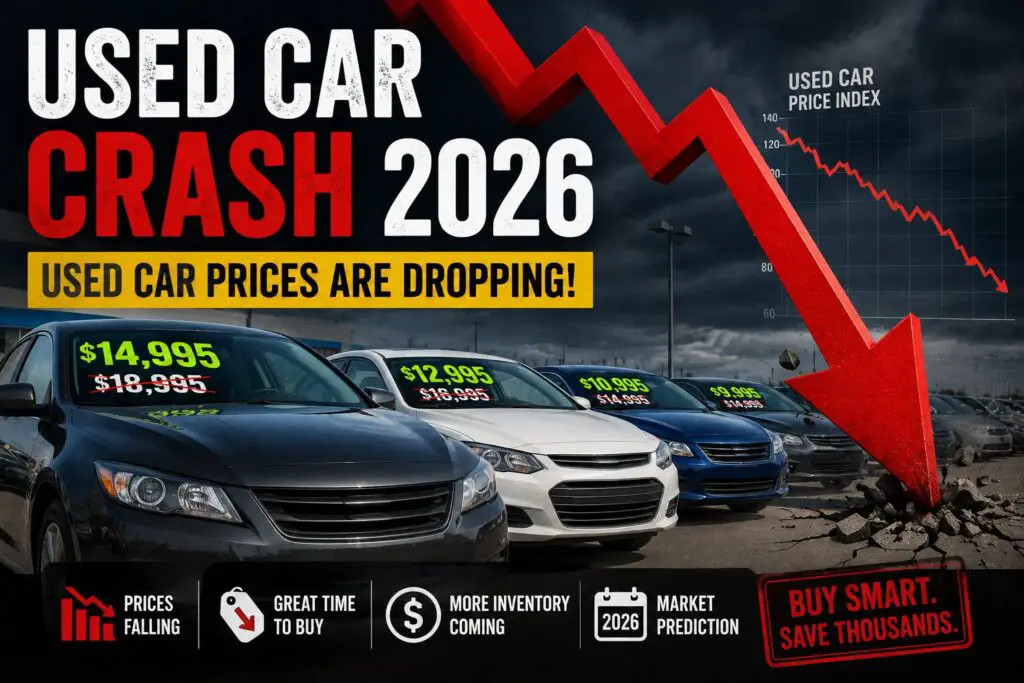
The used-car market is changing, but the direction and size of price moves differ by model and location. After three years of elevated prices and low inventory, a perfect storm of market conditions is converging: automakers are flooding the market with new vehicles, supply chain issues are resolved, and consumers are stretched thin financially. The result? A buyer’s market is finally returning.
If you’re considering buying a used car, timing matters. This guide breaks down what’s happening in the market, what prices will look like, and the smart strategy for buying.
Why Used Car Prices Are About to Crash
Reason #1: Record-High Used Car Inventory
The inventory crunch that lasted from 2021-2024 is completely reversed. Auto manufacturers produced record vehicles in 2023-2024, and those vehicles are now hitting the used car market. When you flood the market with supply and demand stays flat, prices must drop to clear inventory.
Current situation (May 2026): Used car inventory is 15-20% higher than the long-term average. Dealers are desperate to clear lots, especially as new vehicle production continues.
Reason #2: Weakening Consumer Demand
High interest rates (5-8% for used car loans) are pricing out buyers. Monthly payments on a $20,000 used car are $400-500+ per month — beyond what many families can afford. Lower demand + higher supply = lower prices.
Additionally, new car prices are becoming more competitive. A 2026 new economy car costs less today than a 2022 used equivalent. This makes consumers rethink buying used.
Reason #3: Supply Chain Normalization
Chip shortage pressures have eased. Manufacturers can now produce vehicles at normal capacity, flooding the market with new inventory. More new cars = fewer people buying used = downward pressure on used prices.
Reason #4: Economic Uncertainty
Inflation remains elevated, unemployment is rising slightly, and consumer confidence is declining. People hold onto their cars longer, trading them in less frequently. Fewer trade-ins = fewer used cars for sale in the short term, but when they do arrive, they must sell quickly to move inventory.
Used Car Price Predictions 2026-2027
Based on industry forecasts, dealer data, and market trends:
| Price Category | Current (May 2026) | Predicted (Dec 2026) | Predicted (Mid-2027) | Total Drop |
|---|---|---|---|---|
| Economy ($10-15K) | $13,200 | $12,500 | $12,000 | -9% |
| Mid-Size ($15-25K) | $20,500 | $19,000 | $18,000 | -12% |
| Premium ($25-35K) | $31,000 | $27,500 | $26,000 | -16% |
| Luxury ($35K+) | $42,000 | $38,000 | $35,000 | -20% |
Should You Buy Now or Wait?
Use this calculator to see how much YOUR specific car will depreciate:
💰 Used Car Depreciation Calculator 2026
See how much your used car will depreciate through 2026-2027
What’s the car worth right now?
Choose your car’s price range
Buy NOW If:
- ✓ Your current car is breaking down or unsafe (no choice)
- ✓ You need a car for work/family (immediate need)
- ✓ You found a specific model at great discount (early birds getting deals)
- ✓ You’re buying a truck (prices already dropping, inventory high)
- ✓ You plan to keep the car 10+ years (long holding period justifies buying sooner)
WAIT Until Late 2026/Early 2027 If:
- ✓ Your current car is running fine (no immediate need)
- ✓ You’re flexible on model/year (can wait for best deals)
- ✓ You have time to save more money (prices falling = lower down payments needed)
- ✓ Interest rates are expected to drop (waiting means cheaper financing)
- ✓ You want maximum selection (Q4 2026 = most inventory, best negotiating position)
- ✓ You’re buying a mid-size sedan or SUV (biggest drops predicted)
Which Car Models Are Dropping Most?
Models dropping fastest (highest inventory):
- Pickup Trucks: F-150, Silverado, Ram — inventory up 25%+ (biggest inventory bloat)
- SUVs: CR-V, CRV, Escape, Cherokee — oversupplied (expected to drop 12-16%)
- Sedans: Civic, Corolla, Accord — moving slowly (expect 8-12% drops)
- Luxury Brands: BMW, Mercedes, Lexus — inventory high, cutting prices aggressively
Models holding value better (lower inventory):
- EVs (older models): Used Tesla, Chevy Bolt prices holding (newer EVs stealing sales)
- Hybrids: Prius, Hybrid Civic — still in demand, slower price drops
- Specialty: 4×4 trucks, performance cars — niche demand supports prices
Smart Buying Strategies for the Crash
Strategy #1: Negotiate Aggressively
Dealers are desperate to move inventory. Don’t accept asking prices. With inventory this high, you should expect 10-15% discounts off asking price by late 2026. Always get multiple quotes and let dealers know you’re comparing.
Strategy #2: Buy End-of-Month/Quarter
Sales incentives are highest at month-end and quarter-end when dealers need to hit quotas. Inventory is also higher (more to choose from). September-October are peak for aggressive pricing.
Strategy #3: Target High-Inventory Models
Trucks, popular SUVs, and base-model sedans are most oversupplied. These will see the steepest discounts. If you’re flexible on model, choosing a high-inventory vehicle saves you thousands.
Strategy #4: Cash vs Financing
Interest rates are high (5-8%), but used car markets are soft. You have leverage. Dealers prefer quick sales. Offering cash or larger down payment can get better discounts on purchase price.
Strategy #5: Buy Private Party
Private sellers are less aware of market conditions and are often motivated to sell quickly. You could find 15-20% better deals buying directly from owners than dealerships.
What About Trade-In Values?
If you’re trading in your current car to buy another:
- Trade-in values falling too — Dealers buy used cars at wholesale prices, which are dropping faster than retail
- You’re getting hit twice — Your trade-in worth less, AND the car you’re buying costs less
- Sell private instead — If possible, sell your current car private party and buy the next car separately. You’ll come out ahead vs trading in
The Financing Wildcard: Interest Rates
Even if prices drop, high interest rates are keeping payments high. A $20,000 car at 6% interest = ~$400/month (60-month loan). At 8% = ~$440/month.
What if interest rates drop? That’s the real game-changer. If rates fall to 3-4% by late 2026, you could get a better deal on the same car with lower payments.
FAQ: Used Car Crash 2026
Q: How confident are forecasters about these price drops?
A: Very confident. Inventory data, production reports, and dealer feedback all point the same direction.
Q: Will ALL cars drop equally?
A: No. High-inventory models (trucks, popular SUVs) drop 15-20%. Low-demand models drop less.
Q: Is this good news for car buyers?
A: Yes, if you’re buying. Bad news if you’re selling. For buyers, it’s the best market in 3 years.
Q: When should I buy if I’m undecided?
A: Q4 2026 (October-December) offers maximum inventory + aggressive dealer pricing.
Bottom Line
The used car market is shifting. After years of inflated prices and scarce inventory, a buyer’s market is finally returning. Prices are predicted to drop 10-20% through 2026 and into 2027.
The smart move: If you don’t urgently need a car, wait until late 2026 or early 2027 when prices are lowest and dealer inventory is highest. If you need a car now, negotiate aggressively using these low-inventory conditions as leverage.
Either way, 2026 is shaping up to be the best used car buyer’s market in years.


