
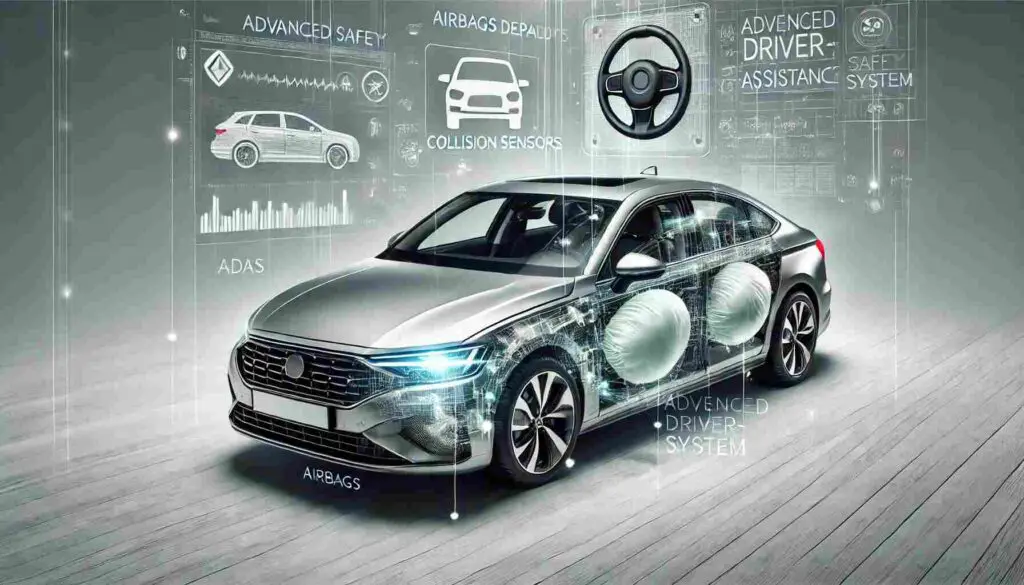
Updated September 2026. The most useful car safety features help prevent common crashes, protect people when a crash happens, and reduce blind spots around the vehicle. For most buyers, automatic emergency braking, strong crash-test results, blind-spot warning, lane-departure warning, and good headlights deserve priority over convenience technology.
Best car safety features to prioritize
| Feature | What it does | Buyer priority |
|---|---|---|
| Automatic emergency braking (AEB) | Applies the brakes when a forward crash is imminent | High |
| Pedestrian AEB | Detects a pedestrian ahead and may brake automatically | High |
| Forward collision warning | Warns when the vehicle is closing on traffic ahead | High |
| Blind-spot warning | Warns about vehicles in adjacent blind spots | High |
| Rear cross-traffic warning | Warns about crossing traffic while reversing | High |
| Lane-departure warning | Warns when the vehicle unintentionally leaves its lane | Useful |
| Lane-keeping assistance | Provides steering input to help return to the lane | Useful |
| Adaptive cruise control | Adjusts speed to maintain a preset following distance | Useful for highway driving |
1. Automatic emergency braking
AEB watches for an imminent forward collision and automatically applies or increases braking if the driver does not respond quickly enough. Pedestrian AEB performs a similar role when the system detects a person ahead. NHTSA lists both among recommended driver-assistance technologies.
AEB performance varies by vehicle, speed, lighting, weather, and the type of object detected. Check whether the exact vehicle includes daytime and nighttime pedestrian detection and review independent test results.
2. Blind-spot and rear cross-traffic warnings
Blind-spot warning uses sensors to detect vehicles beside or slightly behind your car and usually displays a warning near the side mirror. Some vehicles also provide steering or braking intervention if the driver begins moving into an occupied lane.
Rear cross-traffic warning is especially useful when backing out between large parked vehicles. It can detect approaching traffic outside the normal rear-camera view. Rear automatic braking goes further and may apply the brakes.
3. Lane-departure and lane-keeping systems
Lane-departure warning alerts the driver when the car approaches or crosses lane markings unintentionally. Lane-keeping assistance may add steering input. Lane centering provides more continuous steering support on suitable roads.
These systems depend on visible lane markings and can perform poorly in construction zones, snow, heavy rain, glare, or on roads with faded lines. The driver must remain attentive and in control.
4. Adaptive cruise control
Adaptive cruise control maintains a selected speed and adjusts it to keep a preset distance from traffic ahead. Some systems work only above certain speeds; others can handle stop-and-go traffic. It reduces workload on long trips but does not replace braking awareness or steering responsibility.
5. Cameras, parking sensors, and visibility
A rearview camera helps reveal the area behind the vehicle, while parking sensors warn about nearby objects. A 360-degree camera can make tight spaces easier to judge. Rear cross-traffic warning adds coverage for vehicles moving across your path.
Camera lenses can be blocked by dirt, rain, snow, or glare. Test the image in daylight and darkness, and check that replacement cameras have been calibrated correctly after repairs. See our guide to parking sensors and cameras.
6. Headlights and nighttime safety
Headlight performance can vary widely. Automatic high beams switch between high and low beams when traffic is detected. Curve-adaptive headlights turn with steering input to illuminate bends. Review independent headlight ratings and test visibility on an unlit road when possible.
7. Crash protection still matters
Crash-avoidance technology cannot prevent every collision. Seat belts, airbags, head restraints, a strong occupant compartment, effective crumple zones, electronic stability control, anti-lock brakes, and correctly installed child restraints remain essential. Compare crash-test results for the exact model year because structural designs and ratings can change.
Driver-assistance is not self-driving
NHTSA explains that Level 0 features give warnings or momentary intervention, Level 1 assists with steering or speed, and Level 2 can assist with both. In these systems, the driver remains responsible for monitoring the road and operating the vehicle. Feature names such as “pilot,” “assist,” or “autopilot” do not remove that responsibility.
Used-car safety checklist
- Search the VIN for open recalls at NHTSA Recalls.
- Confirm safety equipment on the original window sticker or VIN build sheet.
- Check that no airbag, ABS, stability-control, camera, or sensor warning lights remain on.
- Test AEB, lane, blind-spot, camera, and parking systems during a safe test drive.
- Ask whether windshield, bumper, camera, or sensor repairs required calibration.
- Review NHTSA and IIHS ratings for the exact model year.
- Have an independent mechanic inspect previous collision repairs.
Frequently asked questions
Which car safety feature should I prioritize first?
Start with strong crash-test results and automatic emergency braking. Blind-spot warning, rear cross-traffic warning, and good headlights are also valuable for everyday driving.
Does AEB stop every crash?
No. It may avoid some crashes or reduce impact speed, but its performance depends on conditions and system design.
Can lane-keeping assistance drive the car?
No. It provides limited assistance. The driver must stay attentive, monitor traffic, and remain ready to steer and brake.
Are safety features expensive to repair?
Cameras, radar sensors, windshields, and bumpers may require calibration after repair. Ask for calibration records when buying a previously damaged vehicle.
Official safety resources
Technology availability and performance differ by trim and model year. Verify the exact vehicle before purchase and treat every assistance system as a backup to attentive driving.


