
–>
2026 Hyundai Ioniq 5 Price Cut: New MSRP, Trim Pricing, and Whether It’s Actually a Good Deal
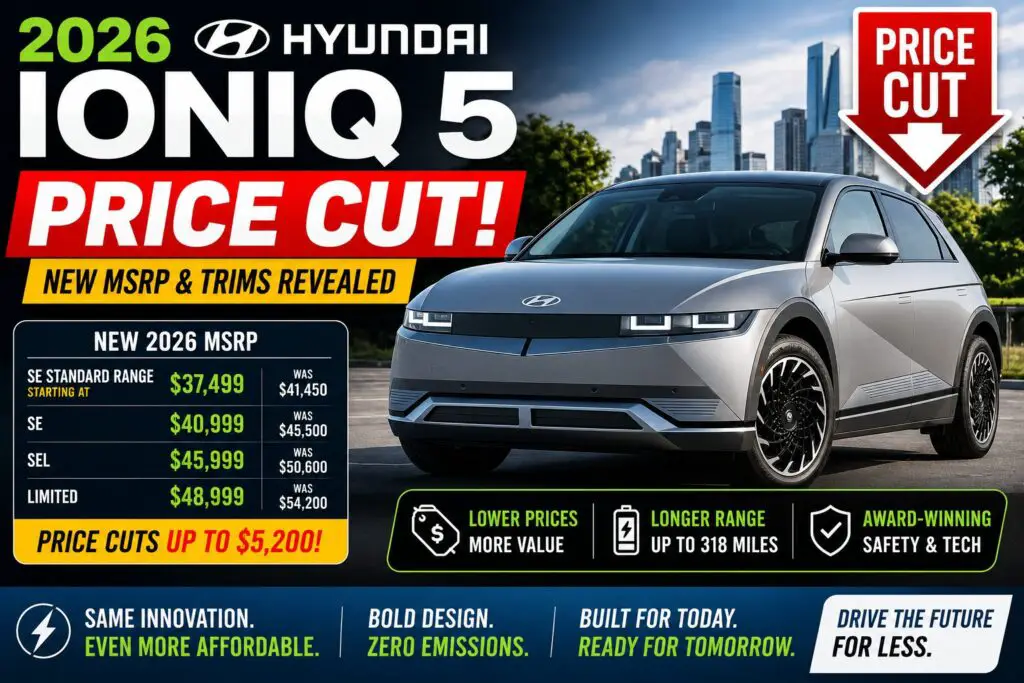
Quick answer: Hyundai lowered the 2026 Ioniq 5 by $7,600 to $9,800 per trim, an average cut of about $9,155 across the lineup. The entry SE Standard Range now starts at $35,000 (before the $1,600 destination charge), down from $42,600. The catch: this offsets the loss of the federal EV tax credit, so your real out-the-door cost may be similar to before, just structured differently. Here’s the full breakdown.
How Much Did the 2026 Ioniq 5 Price Drop?
In a lineup-wide repositioning, Hyundai cut the 2026 Ioniq 5’s MSRP by:
- $7,600 on the entry SE Standard Range RWD
- Up to $9,800 on the SEL RWD and SEL AWD trims (the largest cuts)
- $9,155 average reduction across the full lineup
The headline number: the Ioniq 5 lineup now starts at $35,000 for the SE Standard Range RWD, before a $1,600 destination/freight charge. That makes it one of the better-value compact electric SUVs on the market today.
2026 Hyundai Ioniq 5 Trim Pricing
Here are verified starting prices for key 2026 trims. The lineup is largely a carryover from 2026, so the main change is the price, not the hardware.
| Trim | Drivetrain | Starting MSRP* | Notes |
|---|---|---|---|
| SE Standard Range | RWD | $35,000 | Entry model; smaller battery |
| SE | RWD | $37,500 | Larger battery; more range |
| SEL | RWD / AWD | Largest cut (up to $9,800) — verify | Mid-tier; popular configuration |
| Limited | RWD | $45,075 | Top comfort/tech features |
| XRT | AWD | $46,275 | Rugged styling; more ground clearance |
| XRT w/ Tow Hitch | AWD | $48,325 | Range-topping configuration |
*Starting MSRP excludes the $1,600 destination charge, taxes, and fees. Figures are accurate as of the most recent pricing announcement but may have changed — verify before purchase. Kelley Blue Book Fair Purchase data has suggested buyers were paying roughly $625–$1,375 under MSRP depending on trim, so there may be additional room to negotiate.
Why Did Hyundai Cut the Price?
The price cut is a direct response to a changed market. The short version:
- The federal EV tax credit went away. The $7,500 credit that helped many EV buyers is no longer available the way it was. Rather than let the Ioniq 5 effectively get more expensive, Hyundai lowered the sticker price to keep monthly payments competitive.
- U.S. production ramped up. Hyundai now builds the Ioniq 5 at its plant in Savannah, Georgia, which supports more competitive pricing and supply.
- Competition got fierce. Tesla, Chevy, Toyota, and others are all fighting for the same shoppers. A lower MSRP keeps the Ioniq 5 in the conversation.
2026 vs. 2026 Ioniq 5: Which Is the Better Deal?
This is the question that trips up a lot of buyers. The 2026 model is mostly a carryover, so the choice usually comes down to price and incentives, not features.
| Factor | 2026 Ioniq 5 | 2026 Ioniq 5 (leftover) |
|---|---|---|
| Sticker price | Lower MSRP across the board | Higher MSRP, but heavy dealer discounts |
| Incentives | Price cut replaces the old credit | May still carry cash incentives on remaining stock |
| Features | Minor software/charging refinements, new colors | Nearly identical hardware |
| Selection | Full range of trims and colors | Whatever is left on the lot |
| Depreciation | Newer model year holds value slightly better | Older model year starts depreciating sooner |
Bottom line: If a leftover 2026 is discounted below the equivalent 2026 trim and still carries a cash incentive, it can be the better total deal, since the cars are mechanically almost the same. If you want maximum selection, the newest model year, and slightly better resale, the 2026 is the safer pick. Compare the final out-the-door price on the specific car, not the model year.
How the 2026 Ioniq 5 Compares to Rivals
With its lower price, the Ioniq 5 lands right in the heart of the compact electric SUV class. Here’s roughly how starting prices line up.
| Model | Approx. Starting Price* | Quick Note |
|---|---|---|
| Hyundai Ioniq 5 | From $35,000 | Fast charging, strong range, award winner |
| Chevrolet Equinox EV | Slightly below Ioniq 5 | Strong value, good range |
| Toyota bZ | Around / below Ioniq 5 | Toyota reliability reputation |
| Ford Mustang Mach-E | Around $40,000 | Sportier driving feel |
| Volkswagen ID.4 | Around $40,000 | Roomy, simple to live with |
| Tesla Model Y | Mid-$40,000s (Standard just under $40K) | Supercharger network, best-seller |
*Approximate starting prices for comparison only, exclude destination and fees, and change frequently. Confirm current pricing with each manufacturer. Note: the Ioniq 5 now ships with a Tesla-style NACS charging port from the factory, giving it access to many Tesla Superchargers.
Estimate Your Monthly Payment
Enter a price and your own loan terms to get a rough monthly payment. This is an estimate only — it does not include taxes, registration, insurance, or dealer fees.
Ioniq 5 Payment Estimator
Use the rate you’ve been quoted. Rates vary by credit and lender.
Estimate only. Excludes taxes, title, registration, insurance, and dealer fees. Not a loan offer or financial advice.
Is the 2026 Ioniq 5 Worth Buying?
Strong reasons to buy:
- Lower price makes it one of the better-value electric SUVs available
- 800-volt architecture supports very fast charging (roughly 10% to 80% in about 20 minutes on a strong DC charger)
- Competitive range, with some trims rated around 300 miles
- Built-in NACS port means access to many Tesla Superchargers
- Award-winning design, roomy cabin, and a track record of strong reviews
Reasons to pause:
- Without the old tax credit, the lower price mostly restores value rather than adding new savings
- Higher interest rates can still push monthly payments up — run your own numbers
- A discounted leftover 2026 may be the cheaper total deal for nearly the same car
- If you can’t charge at home, daily ownership is less convenient
Frequently Asked Questions
How much cheaper is the 2026 Ioniq 5?
Hyundai reduced prices by $7,600 to $9,800 per trim, an average of about $9,155. The lineup now starts at $35,000 before destination.
Does the 2026 Ioniq 5 qualify for the federal EV tax credit?
The federal EV tax credit that previously applied is no longer available the way it was. Hyundai’s price cut is designed to offset that loss. Always confirm current federal and state incentive eligibility before you buy, since rules change and can vary by state.
Is the 2026 different from the 2026 Ioniq 5?
Mechanically they are nearly identical. The 2026 adds minor software and charging refinements and new colors. The biggest change is the lower price.
How fast does the Ioniq 5 charge?
Thanks to its 800-volt system, on a strong DC fast charger it can go from about 10% to 80% in roughly 20 minutes. Real-world times depend on the charger and conditions.
Can the Ioniq 5 use Tesla Superchargers?
The 2026 model comes with a Tesla-style NACS port from the factory, which gives it access to many Tesla Supercharger locations. Confirm specific station compatibility before a trip.
Where is the Ioniq 5 built?
Hyundai produces the Ioniq 5 at its manufacturing plant in Savannah, Georgia, which supports its competitive U.S. pricing.
The Bottom Line
The 2026 Hyundai Ioniq 5’s price cut is real and meaningful: an average of about $9,155 off, with a new starting point of $35,000. It makes an already excellent electric SUV more competitive against the Tesla Model Y, Chevy Equinox EV, and others. Just remember that the cut largely replaces the old tax credit rather than stacking on top of it, so judge any deal by the out-the-door price and your total monthly cost — and price a discounted leftover 2026 before you decide.
Use the payment estimator above to run your own numbers, then compare a 2026 Ioniq 5 against a discounted 2026 leftover on the exact trim you want. Get an out-the-door quote in writing before you commit.
Disclaimer: Pricing, incentives, and tax rules referenced here can change at any time and may vary by location and individual circumstances. This article is for general consumer information only and is not financial, tax, or legal advice. Verify all figures with Hyundai, your dealer, and a qualified professional before making a purchase decision.


