
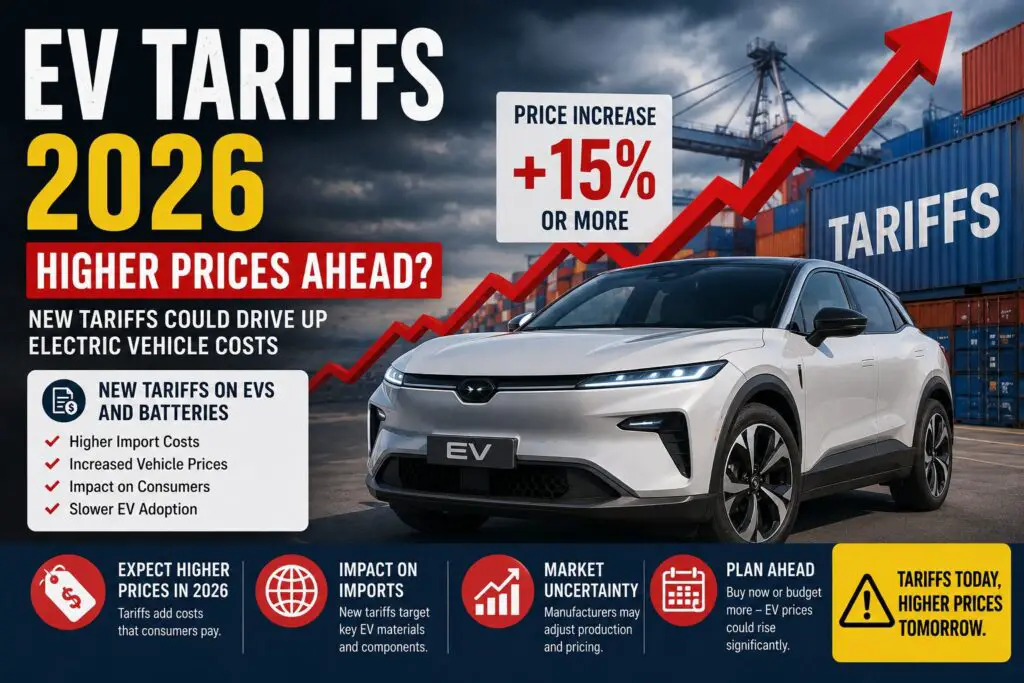
The electric vehicle market is about to face a massive tariff shock. Starting in June 2026, a 25% tariff on imported vehicles and auto parts will fundamentally change EV pricing in America. This isn’t theoretical — it’s happening NOW, and it will cost EV buyers thousands of dollars more.
If you’re considering buying an electric vehicle, understanding these tariffs is critical. This guide breaks down which EVs are affected, how much more they’ll cost, and whether you should buy before or after tariffs take effect.
What Are These EV Tariffs?
The basic facts:
- 25% tariff on imported vehicles — Effective June 3, 2026. Applies to cars assembled outside the US, including imported Tesla vehicles, BMWs, Audis, and most EVs.
- 25% tariff on auto parts — Effective May 2026 (phased). Applies to batteries, semiconductors, motors, and components imported from outside North America.
- Who gets hit: Tesla (imports from China & Mexico), BMW, Audi, Mercedes, Volkswagen, Hyundai, Kia, and any EV with imported components.
- Who’s protected: Chevrolet (GM domestic), Ford, some vehicles assembled in US-Mexico-Canada plants (USMCA compliant).
The Real Impact: How Much Will EV Prices Increase?
Price increases by vehicle category (June 2026 onward):
| EV Model | Current Price | After Tariff | Price Increase | Hit Level |
|---|---|---|---|---|
| Tesla Model 3 | $43,000 | $48,500 | +$5,500 (+13%) | 🔥🔥 HIGH |
| Tesla Model Y | $52,000 | $59,000 | +$7,000 (+13%) | 🔥🔥 HIGH |
| BMW i4 | $60,000 | $69,500 | +$9,500 (+16%) | 🔥🔥🔥 SEVERE |
| Audi e-tron GT | $102,000 | $118,000 | +$16,000 (+16%) | 🔥🔥🔥 SEVERE |
| Chevy Bolt (Domestic) | $28,000 | $29,500 | +$1,500 (+5%) | ✓ SAFE |
| Ford Mustang Mach-E | $42,000 | $46,000 | +$4,000 (+10%) | 🔥 MODERATE |
| Hyundai Ioniq 5 | $44,500 | $51,500 | +$7,000 (+16%) | 🔥🔥🔥 SEVERE |
Should You Buy Before or After Tariffs?
This decision mirrors the broader vehicle market — for the full picture across all car types, see our Car Tariffs 2026 buying guide.
Use this calculator to see how much an EV tariff will cost YOU:
💰 EV Tariff Cost Calculator 2026
See how much tariffs will add to your EV purchase price
Current MSRP before tariffs
What type of EV are you buying?
Buy BEFORE Tariffs (May/Early June 2026) If:
- ✓ You’re buying Tesla, BMW, Audi, or other imported models (biggest tariff hit)
- ✓ You’re flexible on timing and can buy in the next 30-60 days
- ✓ You’ve been wanting an EV and were planning to buy soon anyway
- ✓ You want to lock in current prices before they jump
- ✓ The model you want has good inventory available now
Buy AFTER Tariffs (Late 2026+) If:
- ✓ You’re buying a domestic EV (Chevy Bolt, Ford Mustang Mach-E) — lower tariff impact
- ✓ You can wait and prices might stabilize or drop after initial shock
- ✓ You’re hoping manufacturers absorb some tariff costs (possible)
- ✓ You want to see how the market adjusts after tariffs take effect
- ✓ You’re not in a rush and can wait for inventory to adjust
Which EV Models Get Hit Hardest?
🔥 MOST AFFECTED (13-16% price increases):
- Tesla Model 3 & Y — Mostly imported from China/Mexico
- BMW i4, i7 — Assembled in Germany
- Audi e-tron GT — Full import from Germany
- Hyundai Ioniq 5, EV6 — Assembled in South Korea
- Kia EV9, Niro EV — Assembled in South Korea
- Mercedes-Benz EQC, EQE — Imported from Germany
- Porsche Taycan — Full import from Germany
🟢 LEAST AFFECTED (5-10% increases):
- Chevrolet Bolt EV — Assembled in Michigan (mostly domestic parts)
- Ford Mustang Mach-E — Assembled in Mexico (USMCA compliant)
- GM Equinox EV — Assembled in Tennessee
- Cadillac Lyriq — Assembled in Tennessee
Will Manufacturers Absorb the Cost?
Unlikely (here’s why):
- EV profit margins are already thin (typically 3-7%)
- A 25% tariff is bigger than total profit margin
- Manufacturers can’t absorb 13-16% cost increases
- Most will pass costs directly to consumers
- Some may adjust product mix or source differently, but that takes months
Possible adjustments (slower to happen):
- Shift production to US/Mexico to avoid tariffs (6-12 months)
- Reduce features/price points in some models
- Offer rebates or financing incentives to offset prices
- But these are slow changes — immediate impact is price increases
Smart EV Buying Strategies for Tariffs
Strategy #1: Buy Before Mid-June 2026
Get your order in before June 3 (or before dealer inventory reflects tariffs). Most dealers are already preparing — call NOW and ask about available inventory and delivery timelines.
Strategy #2: Switch to Domestic EVs
If you’re flexible on brand, choosing a US-assembled EV (Chevy Bolt, Ford Mach-E) saves you $3,000-$7,000 compared to imported models. The tariff impact is 50% lower.
Strategy #3: Negotiate Hard
Dealers will be scrambling to clear pre-tariff inventory in May-June. You have leverage. Don’t accept asking prices. Demand 10-15% discounts as dealers want to move stock before tariffs spike their own costs.
Strategy #4: Look for Used/Certified Pre-Owned
Used EV market will flood as people try to sell before tariff-driven price increases. May-July 2026 = best time to buy used EVs at discount prices before tariffs push new car prices up and inflate used market values.
Strategy #5: Consider Federal Tax Credits
Federal EV tax credits ($7,500) still apply. Make sure you qualify. If you can get credit + buy before tariffs, you’re saving $10,000-$15,000 total (tariff avoidance + tax credit).
Impact on EV Adoption & Market
Long-term effects:
- EV sales will dip — Higher prices = fewer buyers. Expect 10-20% sales decline in July-December 2026
- Price-sensitive buyers priced out — $30K EV budget buyers can no longer afford $35K+ post-tariff prices
- Domestic manufacturers benefit — GM, Ford gain competitive advantage (lower tariff impact)
- Premium EV buyers least affected — Luxury buyers care less about $8K increase on $100K purchase
- Eventual adjustment — By 2027, manufacturers will adjust sourcing, prices may stabilize slightly lower
FAQ: EV Tariffs 2026
Q: Do these tariffs apply to all EVs?
A: Primarily imported EVs and models with imported components. US-assembled vehicles face lower impact. Tesla (partly imported), BMW, Audi, Mercedes, Hyundai, Kia hit hardest.
Q: Can I avoid tariffs by buying used?
A: No, but used market prices will also increase as new car prices rise. However, buying used slightly earlier (before market adjusts) might save money.
Q: Will EV tax credits change?
A: Current credits still available ($7,500). They may be affected by tariff legislation, but as of May 2026, they remain. Use them!
Q: Should I wait for prices to drop after tariff shock?
A: Possibly, but don’t bet on big drops. Initial impact will stick. Some minor adjustments possible in late 2026-2027, but expect new baseline 10-16% higher.
Q: What about Tesla specifically?
A: Tesla heavily imports from Giga Shanghai (China) and Mexico. Model 3/Y hit hardest. Domestic Giga Texas production still ramping. Expect 12-15% price increases.
Bottom Line: Should You Buy an EV Now or Wait?
The answer depends on your situation:
Buy NOW (Before June 3, 2026): If you’re buying an imported EV (Tesla, BMW, Audi, Hyundai, Kia). Tariffs save you $5,000-$15,000. Don’t wait.
Buy LATER (After June 2026): If you’re buying domestic EVs (Chevy, Ford) or can wait 6+ months for market adjustment. Lower tariff impact, but you’ll pay more than current prices.
The real strategy: If you want an EV, buy in the next 60 days while you can still access pre-tariff pricing. After June 3, prices jump and don’t come back down. This is one of the clearest “buy now or pay more later” windows we’ve seen in automotive retail.


