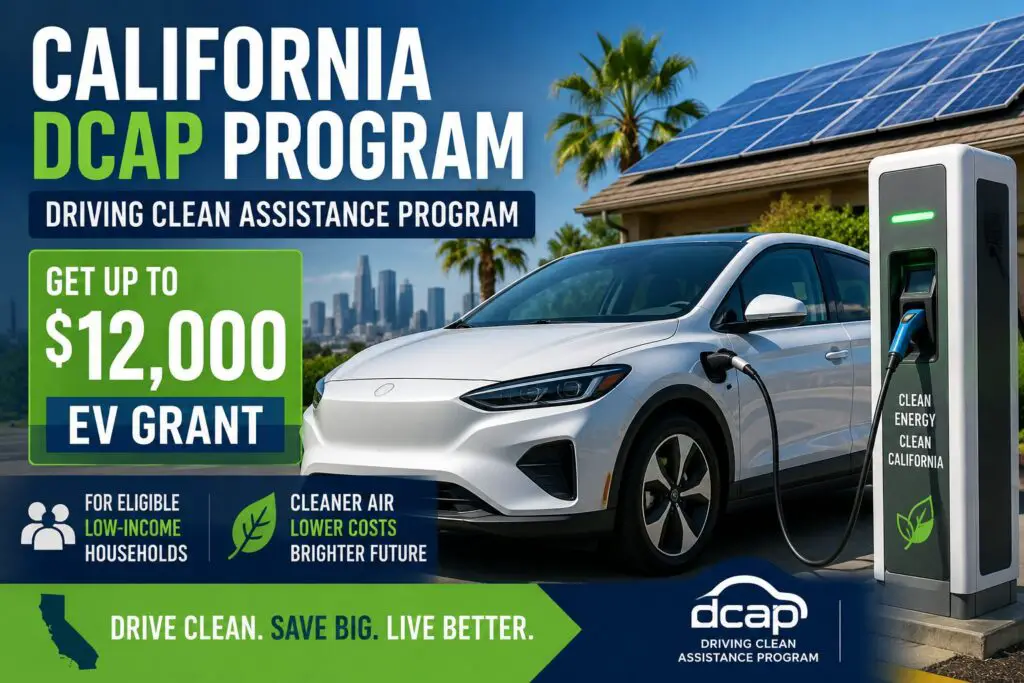
California’s Driving Clean Assistance Program (DCAP) gives low-income families up to $12,000 in free grants to buy an electric vehicle — with no payback required. But time is running out: Tier 2 and 3 funding is closing. Here’s exactly what you need to know to apply before it’s too late.
⚡ Quick AnswerCalifornia’s DCAP program offers up to $12,000 in free grants (no repayment) for low-income residents to buy or lease a new or used electric vehicle. Your household income must be below 300% of the Federal Poverty Level (roughly $99,000 for a 4-person family). You apply BEFORE purchasing a vehicle, get approved in about 12 weeks, and the grant is applied at the dealership. Additional $2,000 available for home EV charger installation or public charging card.
What Is California’s DCAP Program?
DCAP (Driving Clean Assistance Program) is California’s statewide initiative to help low-income families and individuals in disadvantaged communities switch to electric vehicles. It’s funded by California’s Air Resources Board (CARB) and administered by community organizations.
Unlike most incentive programs, DCAP doesn’t just offer a rebate — it also provides financial counseling, access to fair-rate financing (capped at 8% interest), and EV charger assistance. All grants are given upfront and do not need to be repaid.
DCAP vs. Clean Cars 4 All (CC4A) — What’s the Difference?
California has two similar programs. Here’s how they differ:
| Feature | DCAP | Clean Cars 4 All (CC4A) |
|---|---|---|
| Geographic Availability | Statewide (all areas without local CC4A) | Only in specific air districts |
| Requires Vehicle Trade-In? | NO — you can choose two pathways | YES — must scrap old vehicle |
| Max Grant (Scrap/Replace) | $12,000 in DACs | $12,500 in some districts |
| Max Grant (No Trade-In) | $7,500 financing assistance pathway | Not available without trade-in |
| Charger Grant | $2,000 included | Varies by district |
| Financial Counseling | Required | Recommended |
If you live in an area with CC4A AND have a car to scrap: CC4A may offer slightly higher grants. Check your local air district first. If you live outside a CC4A district OR don’t have a vehicle to scrap: DCAP is your option. If you want a grant WITHOUT trading in your old car: DCAP financing assistance pathway ($7,500) is the only choice.
DCAP Grant Amounts — How Much Money You Get
The amount you receive depends on three factors: your location (Disadvantaged Community or not), whether you trade in a vehicle, and what you’re buying.
| Your Situation | Max Grant | Plus Charger Grant | Total Possible |
|---|---|---|---|
| Live in Disadvantaged Community (DAC) + Trade-In | $12,000 | $2,000 | $14,000 |
| NOT in DAC + Trade-In | $10,000 | $2,000 | $12,000 |
| Live in DAC + NO Trade-In (Financing Path) | $7,500 | $2,000 | $9,500 |
| NOT in DAC + NO Trade-In (Financing Path) | $7,500 | $2,000 | $9,500 |
Maria lives in a Disadvantaged Community in Los Angeles and owns a 2008 Toyota Corolla (qualifies for scrap). She applies for DCAP and gets approved for a $12,000 grant. She buys a new Nissan Leaf (MSRP $38,000) from a DCAP-authorized dealer. At the dealership, the $12,000 is applied as a down payment. Maria’s out-of-pocket cost: $38,000 – $12,000 = $26,000 (before taxes/fees). She also gets $2,000 toward a Level 2 home charger installation.
Who Qualifies for DCAP?
DCAP has three main eligibility requirements. You must meet ALL of them.
| Requirement | Details |
|---|---|
| California Residency | Must be a California resident. AB60 (undocumented driver’s license) and ITIN qualify. Provide current address proof (ID, utility bill, lease, etc.) |
| Age | Must be 18 years old or older |
| Income Limit | Household income ≤ 300% of Federal Poverty Level. For 2026: Family of 4 = ~$99,000/year. Varies by household size and updates annually |
| No Previous CARB Incentive | Cannot have participated in CVRP, CVAP, CC4A, or another DCAP before. One incentive per household for life of program |
| Apply BEFORE Purchase | Must apply and receive approval BEFORE buying/leasing vehicle. Grants are NOT retroactive |
Income Eligibility — Am I Below 300% Federal Poverty Level?
300% of Federal Poverty Level depends on household size. Here are 2026 estimates (updated annually):
| Household Size | 300% FPL (Approx) | Examples |
|---|---|---|
| 1 person | ~$42,000 | Single individual |
| 2 people | ~$56,000 | Couple |
| 3 people | ~$70,000 | Family with 1 child |
| 4 people | ~$84,000 | Family with 2 children |
| 5 people | ~$98,000 | Family with 3 children |
| 6+ people | Add ~$14,000 per person | Larger families |
Uncertain about your income level? Visit dcap.communityhdc.org/eligibility and enter your household size and gross income. The tool will instantly tell you if you qualify. No application needed to check.
Vehicle Requirements — Trade-In and Replacement
If You Have a Vehicle to Scrap/Replace (Higher Grant)
Trading in an old car gets you the higher grant amount ($10,000-$12,000). Your trade-in must meet these requirements:
| Requirement | Details |
|---|---|
| Fuel Type | Must be gasoline or diesel-powered. No hybrids, motorcycles, RVs, or boats |
| Model Year | 2010 or older (e.g., for 2026 applications, 2010 and earlier models) |
| Condition | Must be operational and pass a functionality test (runs, doesn’t need to be perfect) |
| Title | Must be titled SOLELY in your name. Joint ownership disqualifies you |
| No Lien | Must be fully paid off with no outstanding loan or lien |
| California Registration | Must be registered in California. Out-of-state vehicles don’t qualify |
| Proof of Operation | Must provide 2 years of proof you owned and operated the vehicle |
The New EV You’re Buying
Your replacement vehicle must meet these specs:
| Requirement | Details |
|---|---|
| Vehicle Type | Battery Electric Vehicle (BEV), Plug-in Hybrid (PHEV), or Fuel Cell Electric Vehicle (FCEV) |
| New or Used? | Both eligible. Used vehicles must be 8+ calendar years new (2018 or newer for 2026) with ≤75,000 original miles |
| Purchase/Lease? | Can purchase or lease. Either option receives the same grant amount |
| Price Cap | Maximum vehicle cost: $45,000 (excludes taxes and fees) |
| CARB Eligibility | New vehicles must be on California Air Resources Board approved list. Used vehicles must be a plug-in hybrid, BEV, or FCEV (any model year) |
| Dealer | Must be purchased through an authorized California dealership. Online-only or out-of-state dealers don’t work |
New EVs: Nissan Leaf (~$29K), Chevy Bolt EV (~$27K), Hyundai Ioniq 6, Tesla Model 3, VW ID.4, Kia Niro PHEV
Used EVs: Used Nissan Leaf, used Chevy Volt, used Tesla Model Y, used Hyundai Kona EV
All must be under $45,000 purchase price and CARB-approved (check carb.ca.gov for full list)
Step-by-Step: How to Apply for DCAP
- Check Eligibility: Visit dcap.communityhdc.org and enter your household size and income. It’s instant and free — no application yet
- Decide on Your Vehicle Trade-In: Do you have a 2010 or older car you want to scrap? (Higher grant if yes)
- Go to drivingcleanca.org: Visit the official DCAP website and download the application form (PDF or online form depending on your region)
- Gather Documents: You’ll need proof of income (last 2 pay stubs or 2026 tax return), proof of California residency (driver’s license, utility bill, lease), and info about your trade-in vehicle (VIN, year, make, model)
- Complete Application: Fill out the form with your contact info, household size, income, vehicle details, and the EV you want to buy
- Submit Application: Mail, email, text, or submit online per the program’s instructions. You’ll get a confirmation number
- Wait for Approval (12 Weeks): DCAP processes applications in the order received. Typical approval time is about 12 weeks. You’ll get a letter or email with approval and your grant amount
- Find DCAP-Authorized Dealer: Look for a California franchised dealer or DCAP broker that accepts the program. Call ahead to confirm they participate
- Make Purchase Appointment: Tell the dealer you’re DCAP-approved and have an approval letter. Schedule a time to pick out your EV
- Purchase Vehicle: Bring your approval letter and ID. The dealer applies the grant as a down payment at point of sale. Sign documents and drive home
- Receive Optional Financing: If approved for financing, your credit union loan (up to $45,000 at <8% APR) is set up through the dealer
- Charger Installation (Optional): If you got a charger grant ($2,000), work with GRID Alternatives partners to install a Level 2 home charger, OR use the $2,000 prepaid card for public charging
DCAP is a pre-purchase program only. You MUST apply and receive approval BEFORE buying or leasing your vehicle. If you buy first, then apply, you are automatically ineligible. The grant cannot be given retroactively.
DCAP Funding Status — URGENT UPDATE
🚨 Tier 2 and Tier 3 Funding is Closing
DCAP rolled out in regional tiers. Tier 1 (Imperial County and remote Central California) is closed. Other tiers are operating, but Tier 2 and 3 funding is exhausted or nearly exhausted as of May 2026.
If you live in Tier 2 or 3 areas (which includes Los Angeles, San Diego, and major metro areas), apply immediately. Funding could close any month. Once closed, you may not be able to apply until the next funding cycle (if one happens).
Visit drivingcleanca.org and check which tier your county is in. If Tier 2 or 3 status shows “Limited Funding” or “Waitlist,” apply TODAY. Do not wait — funding can close without notice.
Two Pathways: Scrap & Replace vs. Financing Assistance
Pathway 1: Scrap & Replace (Higher Grant)
Best if you have an old car to trade in. Trade in a 2010 or older vehicle and get:
- $12,000 grant (if in Disadvantaged Community)
- $10,000 grant (if not in DAC)
- Plus $2,000 charger grant
- No financing required (but available if needed)
Pathway 2: Financing Assistance (No Trade-In Required)
Best if you don’t have a car to scrap. Get a grant + access to fair financing:
- $7,500 grant (same for DAC and non-DAC)
- Plus $2,000 charger grant
- Access to loans up to $45,000 at <8% APR from partner credit unions (if you qualify for financing)
- Financial counseling included
Have a 2010 or older car? Scrap & Replace gets you $10,000-$12,000. Don’t have an old car? Financing Assistance gets you $7,500 + ability to borrow more. You can use both if you have a trade-in but still need financing to cover the rest.
Frequently Asked Questions
Financing Through DCAP — 8% APR
If you need a loan to cover the rest of the vehicle cost, DCAP offers partnerships with credit unions for loans up to $45,000 at an interest rate capped at 8% APR.
Example: You get a $12,000 DCAP grant and want to buy a $38,000 Nissan Leaf. You need $26,000 more. DCAP-partnering credit unions can lend you that $26,000 (or up to $45,000) at <8% APR. Much better rates than typical subprime auto loans (10-12%).
Not all applicants qualify for financing — it depends on your credit history and financial situation. A DCAP financial counselor will review your finances and determine if you qualify.
Finding DCAP-Authorized Dealers
You must purchase your EV from a DCAP-authorized California dealership. Not all dealers participate.
How to find participating dealers:
- Visit drivingcleanca.org (official program website)
- Look for “Find a Dealer” or “Dealer Locator”
- Enter your county. You’ll see all participating dealerships
- Call the dealer BEFORE shopping and confirm: “Do you accept DCAP? Do you have [vehicle model] in stock?”
Note: Different regions partner with different dealerships. Some major chains (Chevrolet, Nissan, Tesla, Hyundai) participate in many areas, but not all locations.