🛡️ INSURANCE 101
Car insurance feels overwhelming — too many coverage types, confusing company names, and prices that vary wildly. But here’s the truth: understanding the basics of car insurance takes just 15 minutes, and knowing what to look for can save you hundreds of dollars per year. This guide breaks down exactly what car insurance is, what you actually need, how to get real quotes, and how to find affordable coverage even on a tight budget.
⚡ Quick AnswerAll states require minimum liability insurance (covers damage you cause to others). Most people need liability + collision + comprehensive coverage. Get quotes from 3-5 companies online (takes 15 minutes). Average cost: $800-$1,500/year. Low-income drivers can get discounts via low-mileage programs, bundling, safety features, or FAIR plans. Ask about discounts — they can save 10-50%.
What Is Car Insurance? (The Basics)
Car insurance is a contract where you pay a company to cover financial losses if you get in an accident, your car is stolen, or damage occurs.
Think of it as protection against catastrophic costs. If you cause a $50,000 accident but don’t have insurance, YOU pay $50,000 out of pocket. With insurance, the company pays it (up to your coverage limits).
Key Insurance Terms:
- Premium: What you pay monthly/yearly for coverage
- Deductible: What YOU pay out-of-pocket before insurance covers the rest (example: $500 deductible means you pay $500, insurance pays the rest)
- Coverage limit: Maximum the insurance company will pay (example: $50,000 liability limit)
- Policy: Your insurance contract listing all coverage and terms
- Claim: A request to insurance company to pay for damage/loss
- State minimum: Lowest insurance amounts your state legally requires
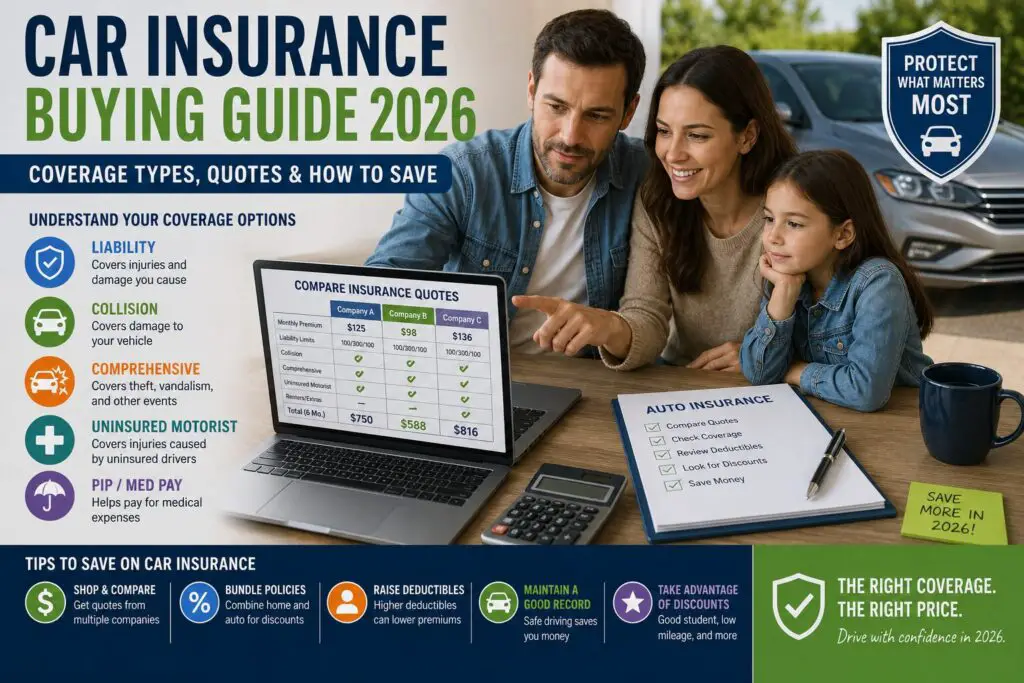
Types of Car Insurance Coverage (Required vs. Optional)
Car insurance comes in different “types” (coverages). Required varies by state, but here’s the breakdown:
| Coverage Type | What It Covers | Required? | Typical Cost |
|---|---|---|---|
| Liability (Bodily Injury) | Covers medical bills of other people injured in accident you caused | ✓ YES (all states) | $25-50/month |
| Liability (Property Damage) | Covers damage to other people’s cars/property in accident you caused | ✓ YES (all states) | $15-35/month |
| Collision | Covers YOUR car damage from collision (accident with another car/object) | ✗ Optional* (*required if you have a car loan) | $50-150/month |
| Comprehensive | Covers YOUR car damage from theft, weather, vandalism, hitting an animal | ✗ Optional* (*required if you have a car loan) | $40-120/month |
| Uninsured Motorist (UM) | Covers you if hit by uninsured driver | ✓ YES (most states require) | $15-35/month |
| Underinsured Motorist (UIM) | Covers you if hit by driver with insufficient insurance | ✗ Optional (recommended) | $10-30/month |
| Medical Payments (MedPay) | Covers medical bills regardless of who caused accident | ✗ Optional (recommended) | $5-15/month |
If your car is financed (you have a loan), the lender REQUIRES collision + comprehensive coverage. You can’t get financing without it. If you own the car outright, collision/comprehensive are optional (but recommended).
State Minimum Insurance Requirements
Every state requires a MINIMUM amount of liability insurance. Here’s the range:
- Bodily Injury (per person): $12,500 – $50,000
- Bodily Injury (per accident): $25,000 – $100,000
- Property Damage (per accident): $12,500 – $50,000
Example minimum from most states: 15/30/5 (=$15K per person, $30K per accident, $5K property damage)
State minimums protect you legally but NOT financially. A single accident could cost $50K+ in medical bills + property damage. Experts recommend liability limits of at least 100/300/100 ($100K/$300K/$100K) or higher. Get quotes at different limits — the difference is often just $10-20/month for much better protection.
Step-by-Step: How to Get Car Insurance Quotes
- Gather your info: Driver’s license, vehicle info (VIN, year/make/model), driving history
- Choose deductible: Decide what YOU’D pay out-of-pocket ($250, $500, $1,000). Higher deductible = lower premium
- Select coverage limits: Start with state minimum + collision/comprehensive (if financing) or 100/300/100 liability
- Visit comparison sites: Go to Bankrate, NerdWallet, QuoteWizard, or insurers directly (Geico, State Farm, Progressive, Allstate)
- Get 3-5 quotes: Each site takes 10-15 minutes. More quotes = better comparison
- Compare apples-to-apples: Same coverage limits across all quotes so you can compare prices fairly
- Check discounts: Ask each company about: bundling (home + auto), safe driver, good student, low mileage, safety features in car
- Review customer service ratings: Check J.D. Power ratings, Google reviews, Better Business Bureau scores
- Pick a company and apply: Can apply online in 5 minutes. Policy starts immediately (usually)
- Pay your premium: Monthly, quarterly, or yearly depending on company
Shop for insurance every 6-12 months. Rates change constantly. You might find a cheaper company and save $200+/year by switching. No penalty for changing insurers.
How to Save Money on Car Insurance (Discounts & Strategies)
Biggest Discounts (10-50% off):
| Discount | Savings | Requirements |
|---|---|---|
| Bundle (Home + Auto) | 15-25% | Have homeowner/renter insurance with same company |
| Good Driver / Clean Driving Record | 10-30% | No accidents/tickets in 3-5 years |
| Safety Features (Anti-theft, Airbags) | 5-15% | Modern car with safety systems (most cars have this) |
| Good Student Discount | 10-15% | GPA 3.0+ (if under 25 and in school) |
| Low Mileage Program | 10-30% | Drive under 10,000-15,000 miles/year |
| Usage-Based (Telematics) | 10-30% | Install app/device that tracks safe driving (Snapshot, Xfinity, etc.) |
| Defensive Driving Course | 5-10% | Complete approved driving safety course |
| Paperless Billing | 3-5% | Get bills via email, not mail |
Ways to Lower Your Premium:
- Increase deductible: Raising from $250 to $1,000 can save $20-50/month
- Drop optional coverages: If car is old (worth <$5K), skip collision/comprehensive, only keep liability
- Pay in full: Paying yearly instead of monthly saves 5-10%
- Ask about all discounts: Many people don’t qualify but should ask anyway
- Improve credit score: Insurance companies use credit scores. Better credit = lower rates
- Move to lower-cost car: Sports cars, luxury cars cost more to insure. Sedans are cheapest
Best Insurance Companies 2026 (Rates & Customer Service)
Top companies by category:
- Cheapest overall: Geico, Direct General, National General
- Best customer service: State Farm, Allstate, USAA (military/families)
- Best for discounts: Progressive (bundling, usage-based), State Farm (good driver discounts)
- Best online experience: Geico, Progressive, Nationwide (easy quotes and claims)
- Best for high-risk drivers: Direct General, National General, SafePoint (DUI/tickets)
- Best for young drivers: Geico, State Farm (good student discounts available)
Reality check: “Best” varies by person. Your age, driving history, location, and car type all affect which company is cheapest for YOU. That’s why comparing quotes is essential.
Affordable Car Insurance for Low-Income Drivers
If you’re on a tight budget, these options help:
1. FAIR Plans (Low-Income Insurance)
- Most states have a “FAIR” plan (Fair Access to Insurance Requirements)
- Designed for people who can’t get regular insurance
- Covers liability only, but much cheaper
- Contact your state’s Department of Insurance for details
2. Low-Mileage Programs
- If you drive <10K miles/year: Get 10-30% discount
- Tell insurer your estimated annual mileage
- Some require telematics device (tracks your driving)
3. Usage-Based Insurance (Telematics)
- Companies: Progressive Snapshot, State Farm Drive Safe, Allstate Drivewise, Geico Drivewise
- How it works: Download app or get device. It tracks safe driving (speed, hard braking, night driving)
- Savings: 10-30% if you drive safely
- Best for: Safe drivers (rewards good behavior)
4. Minimum Coverage Only
- If you own a car outright (no loan), you only legally need liability
- Skip collision/comprehensive if car is worth <$3K
- Saves $50-100/month
- Tradeoff: You pay for any damage to your car
5. Ask About Payment Plans
- Some companies offer payment plans instead of lump sum
- Pay weekly or bi-weekly instead of monthly
- Helps if monthly premium is too high
Common Car Insurance Scams & Red Flags
Watch out for these scams:
- “Instant insurance” without underwriting: Legitimate companies always do background checks. If they don’t ask questions, it’s a scam
- Guaranteed approval: No insurer guarantees approval. All check driving history/credit
- Extremely cheap quotes (too good to be true): If the price is 50% cheaper than others, ask why. Could be bait-and-switch
- Requesting payment by wire transfer or gift card: Legitimate insurers accept bank transfers, checks, or debit cards. Never use gift cards or wire transfer
- Unsolicited calls asking for Social Security Number: Scammers call pretending to be insurance companies. Legitimate companies don’t cold-call asking for SSN
- Website that looks unprofessional: Legitimate insurers have professional websites. Scam sites often have typos, broken links, or poor design
- Not licensed in your state: Check your state’s Department of Insurance to verify company is licensed
Report it to: Your state’s Attorney General, National Association of Insurance Commissioners (NAIC.org), or FBI (ic3.gov). Don’t give them money.
What To Do If You Get in an Accident
- Check for safety: Make sure everyone is okay. Call 911 if anyone is injured
- Move vehicles out of traffic: If safe and cars are driveable, move to shoulder or parking lot
- Turn on hazard lights: Warn other drivers
- Exchange information: Get other driver’s name, phone, address, insurance company, policy number, driver’s license number, vehicle info
- Take photos: Document damage to both vehicles, accident scene, road conditions, traffic signs
- Get witness info: If anyone saw the accident, get their contact info
- File police report: Required in most states if there’s injury or significant damage ($750+)
- Contact your insurance company: Report the accident within 24 hours. Have all info ready
- Keep all documentation: Save photos, police report, medical records, repair estimates
- Don’t admit fault at scene: Let insurance companies determine fault
Frequently Asked Questions
Bottom Line: Start Shopping Today
Car insurance is required and important. But you don’t have to overpay. Spend 30 minutes getting 3-5 quotes online. Compare the same coverage across companies. Ask about all discounts. You’ll likely find a company that costs 20-40% less than what you’re currently paying.
Remember: Shopping for insurance every 1-2 years is normal. Rates change, discounts come and go, and new companies offer better deals. Don’t set it and forget it.
Official Insurance & Government Resources
- NAIC (National Association of Insurance Commissioners) — Insurance Info
- Insure.com — Insurance Education & Quotes
- Insurance.gov — Government Consumer Guide
- Insurance Information Institute — Facts & Statistics
- Your state’s Department of Insurance website (search “[State] insurance commissioner”)