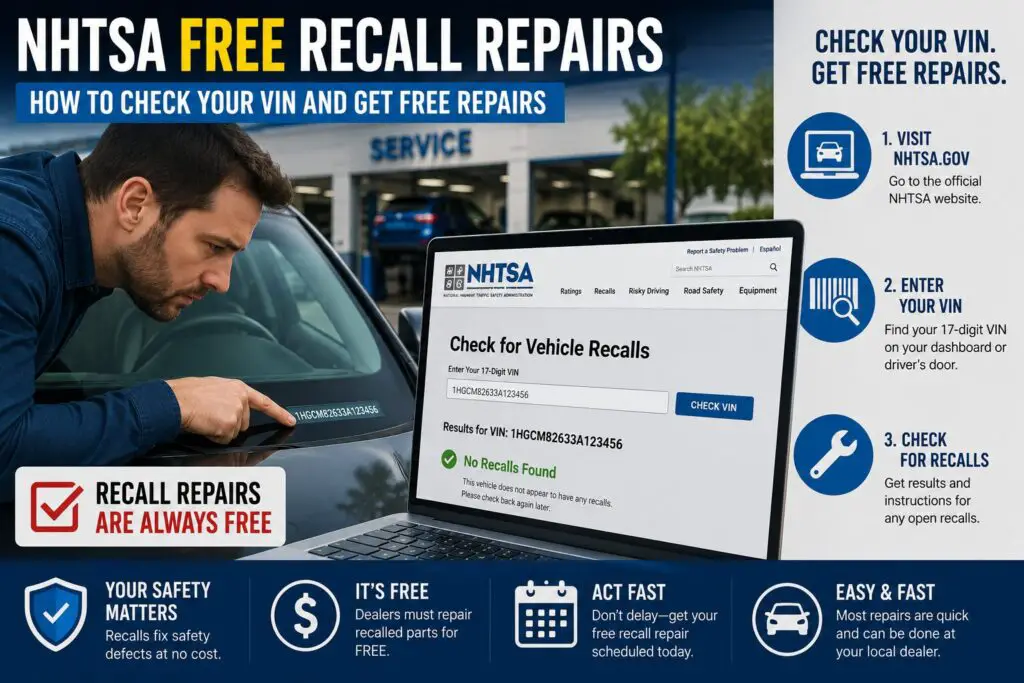
Millions of Americans are driving cars with active safety recalls — and most don’t know it. Here’s the shocking part: manufacturers are legally required to fix these problems for FREE. But about 25% of recalled vehicles are never repaired. If your car is one of them, you’re leaving hundreds or thousands of dollars on the table. Here’s exactly how to find out if your car has recalls and get your free repairs.
⚡ Quick AnswerGo to NHTSA.gov/Recalls and enter your VIN (17-character number on your dashboard). Takes 30 seconds. If your car has an open recall, the manufacturer must fix it for FREE at any authorized dealership — no cost to you, no appointment needed in most cases. Over 29 million vehicles were recalled in 2026 for safety defects. All repairs are completely free. No expiration date. The SaferCar app will alert you to future recalls automatically.
What Is a Vehicle Safety Recall?
A safety recall is issued when a manufacturer or NHTSA (National Highway Traffic Safety Administration) determines that a vehicle, part, or equipment creates an unreasonable safety risk or fails to meet federal safety standards.
Here’s what that means in practical terms: A defect is discovered that could cause injury, death, or property damage. Examples:
- Airbags that don’t deploy correctly
- Brakes that fail unexpectedly
- Engines that stall while driving
- Seatbelts that don’t lock properly
- Steering systems that malfunction
- Fuel leaks that could cause fires
- Software glitches in safety systems
When a recall is issued, the manufacturer MUST fix the problem for FREE. They have no choice — it’s federal law. The manufacturer can do this by repairing the vehicle, replacing the defective part, offering a refund, or in extremely rare cases, repurchasing the vehicle.
In 2026, NHTSA issued 997 safety recalls affecting 29+ million vehicles. That means roughly 1 in 4 cars on the road has an unrepaired recall. Many owners don’t know because they never received the recall notice or didn’t understand it.
How to Check If Your Car Has a Recall (3 Simple Steps)
Step 1: Find Your VIN (2 minutes)
Your Vehicle Identification Number (VIN) is a 17-character code unique to your car. Find it in these locations (in order of easiest):
- Lower left of your windshield — visible from outside, easiest to see
- Inside driver’s side door jamb — open door, look on the sticker/label
- Vehicle registration document — insurance or registration papers
- Insurance documents — your policy or ID card
Step 2: Go to NHTSA.gov/Recalls (1 minute)
Visit NHTSA.gov/Recalls or search “NHTSA recall lookup” in your browser.
You’ll see a simple search interface. You can search by:
- VIN (most specific — shows your exact vehicle)
- License plate (if your state participates)
- Vehicle year, make, and model (shows all recalls for that model)
Step 3: Review Results (1 minute)
The results will show:
| What You’ll See | What It Means |
|---|---|
| “0 unrepaired recalls” | Your car is good — no open recalls. You’re done! |
| Recall campaign number | Unique ID for this specific recall (used when scheduling repair) |
| Defect description | “Airbag may not deploy” or “Brake fluid leak possible” — what’s wrong |
| Safety risk | What could happen: injury, accident, fire, engine stall, etc. |
| Remedy | How it gets fixed: part replacement, software update, inspection, etc. |
| Repair status for YOUR VIN | “Unrepaired” = needs fixing | “Repaired” = already done |
Check for recalls BEFORE buying a used car. Use the VIN from the listing to search. If there are unrepaired recalls, use it as negotiation leverage to get $500–$2,000 off the price (since the dealer will have to fix it eventually).
How to Get Your Recall Repair (Free, No Appointment Usually Needed)
- Get the recall campaign number from your NHTSA search results (starts with “NHTSA” followed by numbers)
- Call any authorized dealership for your vehicle’s brand — doesn’t have to be where you bought it. Example: any Honda dealership can repair your Honda, any Chevy dealer can repair your Chevy
- Tell the dealer: “I need to schedule a recall repair. Campaign number is [XXX]. Here’s my VIN: [XXX]”
- The dealer will confirm the recall applies to your car and schedule the appointment. Usually can be done in 1-2 weeks
- Bring your car in on the scheduled date. Repair is FREE. No appointment fees, no charges. Nothing
- If parts aren’t available immediately, manufacturer may provide loaner vehicle, rental car, or interim fix while parts are being made
You search your VIN and find a recall for your 2016 Toyota Camry: “Engine may stall while driving — electrical system malfunction.” Campaign number: NHTSA 2026-0512.
You call your local Toyota dealership and say: “I need a recall repair for campaign 2026-0512. Here’s my VIN: 4T1BF1AK8CU123456.”
Dealer schedules you for Thursday at 9 AM.
You drop off your car. Repair takes 1-2 hours (software update).
You pick it up. Cost: $0. Done.
Why Don’t People Get Recall Repairs? (And Why You Should)
About 25% of recalled vehicles are never repaired. Why?
| Reason | Reality Check |
|---|---|
| “I never got the recall notice” | Manufacturers mail notices to registration addresses. If you moved or didn’t update registration, you never got it. CHECK ANYWAY — just because you didn’t see the notice doesn’t mean recall doesn’t apply |
| “I forgot about it” | Set a phone reminder right now. Takes 2 minutes to call dealership |
| “I thought the dealer only does recalls where I bought the car” | FALSE. ANY authorized dealership for your brand can do the recall repair |
| “The recall can’t be that serious” | If NHTSA issued it, it’s serious enough to warrant FREE repair by federal mandate. Trust the system |
| “Dealer appointment is inconvenient” | Many recalls are software updates (takes 30 mins) or simple part replacements (1-2 hours). Most dealers offer loaner cars while yours is being serviced |
| “I don’t have time” | Making the phone call takes 5 minutes. Scheduling online may be available. Do it now |
Some recalls come with “Do Not Drive” warnings — meaning the defect is so serious you should not drive the vehicle until it’s repaired. Examples: Takata airbag recalls, brake failures, electrical fire hazards. If your recall search shows a “Do Not Drive” warning, do NOT drive your car. Call the dealer immediately and explain the urgency. They will often fast-track the appointment or provide interim solution
Common Recall Types (What Gets Recalled Most)
Here are the most common safety defects that trigger recalls:
| Recall Type | Safety Risk | Typical Remedy | How Often |
|---|---|---|---|
| Airbag Defects | Airbags don’t deploy or deploy unexpectedly (can injure occupants) | Replace airbag module | Very common |
| Brake System Failures | Brakes fade, don’t work, or fail suddenly | Repair/replace brake lines, pads, fluid | Very common |
| Seatbelt Issues | Seatbelts don’t lock or detach unexpectedly | Replace seatbelt assembly or anchor | Common |
| Engine/Fuel System | Engine stalls, fuel leaks, fire risk | Replace fuel pump, repair fuel lines, software update | Very common |
| Steering Defects | Steering becomes unresponsive or locks up | Replace steering components | Moderate |
| Electrical System | Electrical fires, systems malfunction, lights fail | Replace wiring, modules, software update | Very common |
| Software Glitches | Safety systems malfunction (newer vehicles) | Software update (usually quick) | Increasingly common |
What If You Already Paid for the Repair?
If you paid out-of-pocket for a repair that was later recalled as a safety defect, you may be eligible for reimbursement.
Here’s what to do:
- Find your receipt for the repair you paid for
- Check NHTSA.gov/Recalls to confirm the defect is now under official recall
- Contact the vehicle manufacturer’s customer service with: your VIN, date of repair, receipt, and recall campaign number
- Request reimbursement for the repair cost
- Manufacturers usually approve reimbursement if the repair matches the recalled defect — typically takes 2-4 weeks
Reimbursement is not guaranteed — it depends on manufacturer policy and timing. But it’s worth asking. The worst they’ll say is no. Keep records of all car repairs just in case.
The SaferCar App — Get Alerts Automatically
Instead of manually checking NHTSA.gov every few months, download the FREE SaferCar app.
How it works:
- Download SaferCar from Apple App Store or Google Play
- Enter your VIN and vehicle info
- If a new recall is issued for your vehicle, you get an instant phone notification
- App also shows recalls for car seats, tires, and equipment
- No subscription fee — completely free
This is the easiest way to stay on top of recalls. You don’t have to remember to check — the app notifies you.
If you have multiple vehicles, add all of them to SaferCar. Parents: also add car seats and other equipment. The app consolidates all recalls in one place.
Key Facts About Vehicle Recalls
| Question | Answer |
|---|---|
| Is there a time limit to get a recall fixed? | NO. Recalls never expire. You can get your car repaired years or decades after the recall was issued |
| Do I have to use my original dealership? | NO. Any authorized dealership for your brand can do the repair |
| Will the repair affect my car’s warranty? | NO. Recall repairs do not void any warranty. The manufacturer must cover the repair cost |
| What if my car is financed/leased? | Doesn’t matter. You still get the repair for free. The manufacturer covers the cost, not the lender |
| Can a dealership charge me for a recall repair? | NO. If they try to charge you, report them to NHTSA immediately. It’s illegal |
| How long does a recall repair take? | Varies: software updates (30 mins), part replacements (1-3 hours), complex fixes (half day) |
| What if my vehicle is so old that parts aren’t available? | Manufacturer must still provide a remedy — either loaner, rental car, or interim fix while parts are made |
Frequently Asked Questions
Budget-Friendly Angle: Why This Matters for Low-Income Families
For families on tight budgets, recalls are a huge financial advantage.
- Brake system repair (without recall): $400–$1,500
- Brake system repair (under recall): FREE
- Airbag replacement (without recall): $1,000–$2,500 per airbag
- Airbag replacement (under recall): FREE
- Engine repair (without recall): $1,500–$5,000+
- Engine repair (under recall): FREE
A single recall can save you hundreds or thousands of dollars. Checking for recalls should be part of your car ownership routine — like checking the oil. It takes 5 minutes and could save you thousands.
Official Resources
- NHTSA Vehicle Recall Lookup
- NHTSA SaferCar App (iOS & Android)
- National Highway Traffic Safety Administration (NHTSA) Homepage
- How to Report a Safety Defect
- NHTSA Hotline: 1-888-DASH-DOT (1-888-327-4236)


