
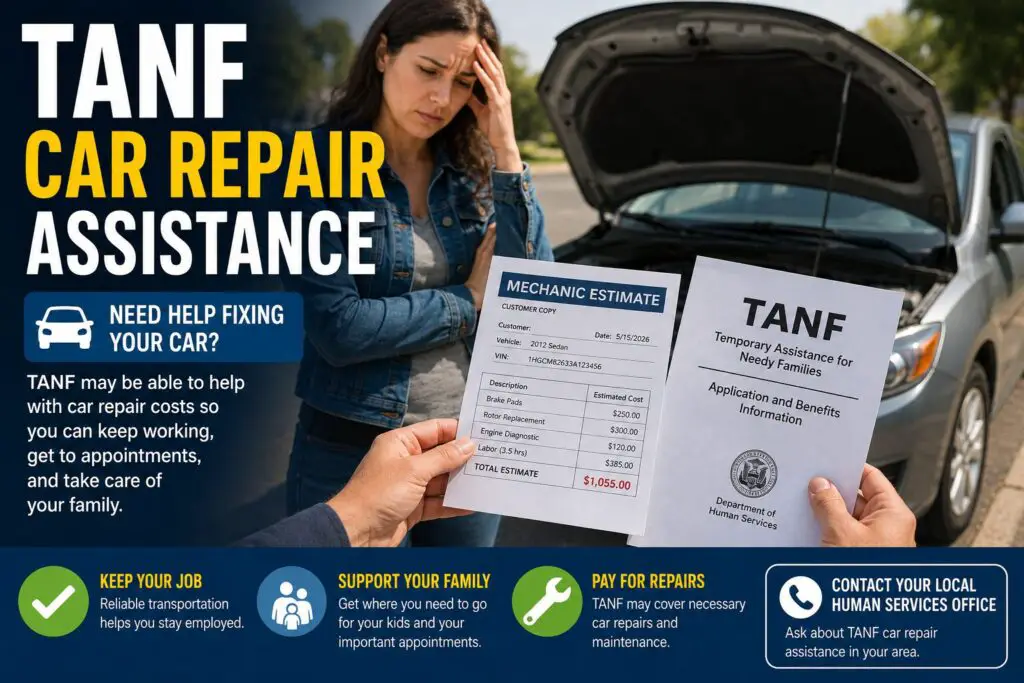
Most people on welfare don’t know their TANF benefits can pay for car repairs. But the truth is: if a broken car is the only thing stopping you from keeping your job, your state’s TANF program can pay to fix it. In many states, this emergency assistance doesn’t even count against your 60-month lifetime TANF limit. Here’s exactly how to get your car fixed using welfare benefits.
⚡ Quick AnswerIf you receive TANF (Temporary Assistance for Needy Families), you can request “diversionary assistance” or “supportive services” to cover car repairs — if the repair is needed to keep your job or get to work. You must apply at your state’s Department of Social Services or Human Services office and explicitly tell your caseworker: “My car repair is the only barrier to keeping my job.” In most states, this assistance is fast-tracked, doesn’t count against your lifetime TANF limit, and can cover $300–$1,500+ depending on the repair and state. Approval usually takes 1-2 weeks for emergency repairs.
What Is TANF Car Repair Assistance?
TANF (Temporary Assistance for Needy Families) is a federal program that gives cash assistance to low-income families. Most people think it only covers rent, food, and childcare. But hidden in TANF rules is a powerful feature: emergency assistance for car repairs.
Here’s how it works:
- You have a working car that breaks down (transmission, engine, brake system, electrical)
- The repair costs $500–$1,500+ — money you don’t have
- Without the repair, you cannot keep your job or get to work/job training
- Your TANF caseworker can authorize “diversionary assistance” — a one-time emergency payment for the repair
- You get the repair done and keep your job
- This assistance usually does NOT count against your 60-month lifetime TANF limit in most states
This is classified as “non-assistance” in TANF terms, meaning it’s specifically designed to prevent job loss. It’s one of TANF’s best-kept secrets.
According to AAA, the average car repair costs $500–$600 in 2026. For a family earning $2,000/month on TANF, this is 25–30% of their monthly income. For many, it’s a choice: repair the car or pay rent. TANF car repair assistance exists specifically to solve this problem.
Who Qualifies for TANF Car Repair Assistance?
You must meet several requirements. Most importantly: you must already be receiving TANF benefits or be eligible for them.
| Requirement | Details | Notes |
|---|---|---|
| TANF Eligible | Must receive TANF or qualify for it (income below 200% of federal poverty line in most states) | Varies by state |
| Have Children | Most states require household to have minor child (under 18) OR pregnant woman | Some states have exceptions for disabled/elderly |
| Vehicle Required for Work | Must prove car is necessary for: employment, job training, interviews, education, or childcare | This is critical — must explain how repair keeps job |
| Repair Cost Documented | Need written estimate from mechanic showing repair cost and what’s broken | Get 2-3 estimates to show reasonable pricing |
| Cannot Afford Repair | Must show you cannot pay for repair out-of-pocket | Simple statement to caseworker is usually enough |
| Vehicle Ownership Proof | Must own or be responsible for the vehicle (title, registration, insurance) | Vehicle must be in good condition (not a junker) |
When you apply, use this exact language to your caseworker: “My car repair is the ONLY BARRIER preventing me from keeping my job.” Caseworkers are trained to look for this language. It signals an emergency use of diversionary funds.
How Much TANF Car Repair Assistance Can You Get?
The amount varies significantly by state. There is no federal cap — each state decides.
| State/Region | Max Assistance | Notes |
|---|---|---|
| California (CalWORKs) | Up to $1,000-$1,500 | For working families; repair must be work-related |
| Texas | Up to $1,200 one-time | Offers specific emergency payment for car repairs |
| Michigan | Up to $900 | Through Employment Support Services |
| New York | Up to $800-$1,000 | Through “Wheels for Work” or caseworker discretion |
| Ohio | Up to $500-$700 | Varies by county; check local office |
| Most Other States | $300-$1,000 | Varies; call your TANF office for specifics |
The actual amount approved depends on:
- Cost of the repair (mechanical quotes matter)
- Your state’s TANF budget and policies
- Urgency of the repair (safety issue = higher priority)
- Your caseworker’s discretion
- Whether you’re actively working or in job training
Some states have very limited car repair funds. If your state can’t cover the full repair cost, they may: offer partial funding, provide a voucher for a specific repair shop, pay the mechanic directly, or refer you to nonprofits for additional help. Don’t assume one “no” is final — ask about all options.
Step-by-Step: How to Apply for TANF Car Repair Help
- Verify you receive TANF — if you already receive TANF/Family Assistance benefits, you’re eligible to apply. If not, contact your state office to see if you qualify first
- Get repair estimate from mechanic — call a trusted mechanic and get a written estimate showing: what’s broken, repair cost, why it’s necessary. Get 2-3 estimates if possible
- Contact your TANF caseworker directly — call the phone number on your TANF documents or visit your local Department of Social Services/Human Services office in person
- Explain the situation explicitly: “My car is broken. The repair costs $[amount]. Without this repair, I cannot keep my job. My car repair is the ONLY BARRIER to keeping my job. Can you help with emergency diversionary assistance?”
- Bring documentation: mechanic estimate(s), vehicle registration/title, proof of employment or job offer, proof that you receive TANF
- Caseworker reviews your case — they will assess whether repair is truly necessary for employment and whether you have funds available
- Get approval (usually 1-2 weeks for emergency) — caseworker will either approve, deny, or offer partial assistance
- Get repair done — if approved, either you get cash to pay mechanic, or TANF pays mechanic directly
- Provide proof of completion — give caseworker receipt/invoice showing repair was done
Call your caseworker directly instead of visiting in person. Explain the urgency: “My car is broken and I’m at risk of losing my job. Can we process emergency diversionary assistance?” Most caseworkers can approve emergency repairs faster by phone than through standard office visits. Follow up with documentation sent by email or in-person.
What Repairs Are Covered?
TANF covers repairs that are NECESSARY to keep the vehicle operational and allow you to work.
| LIKELY COVERED | MAY BE COVERED | UNLIKELY COVERED |
|---|---|---|
| Engine repairs/replacement | Transmission fluid flush | Paint/cosmetic work |
| Brake system overhaul | AC/heater repair (regional) | New stereo system |
| Transmission repair/replacement | Windshield wipers replacement | Wheel upgrades |
| Electrical system repair | Tire replacement (safety issue) | Custom modifications |
| Fuel pump replacement | Alternator/battery (safety-critical) | Regular maintenance (oil changes) |
| Radiator/coolant system | Suspension repair (if safety issue) | Detailing/cleaning |
The key is: “Will this repair allow you to drive the car to work safely?” If yes, it’s likely covered. If it’s cosmetic or optional maintenance, it’s unlikely.
Repairs that affect safety (brakes, steering, engine, electrical) are HIGHEST priority. If your car won’t start or has failed brakes, caseworkers fast-track these. Repairs that are nice-to-have but not critical (AC, new tires for comfort) are lower priority.
Does TANF Car Repair Count Against Your 60-Month Limit?
NO — in most states, car repair assistance is classified as “non-assistance” and does NOT count against your 60-month lifetime TANF limit.
This is a big deal because:
- You get a one-time emergency payment (up to $1,000+) that doesn’t use up your lifetime benefits
- You can still receive regular monthly TANF cash assistance for rent, food, childcare on top of it
- It’s specifically designed as an intervention to keep you working — not counted against you
However, rules vary by state. Some states count it differently. Ask your caseworker explicitly: “Does this car repair assistance count against my 60-month lifetime limit?” Get it in writing if possible.
Other Ways to Get Help If TANF Denies or Can’t Cover Full Cost
If TANF says no or only covers part of the repair, you have backup options:
| Program | What It Covers | How to Access |
|---|---|---|
| Community Action Agencies (CAA) | Up to $1,000 car repair grants; up to $2,000 for vehicle purchase | Search “community action near me” or call 211 |
| 211 United Way Helpline | Connects you to local nonprofits, churches, county programs | Dial 2-1-1 from any phone, 24/7 (fastest option) |
| Modest Needs | $600-$1,000 self-sufficiency grants for emergency transport | Apply at modestneeds.org |
| Local Churches/Faith Organizations | Car repair assistance (varies by church) | Call local churches or ask your caseworker |
| Nonprofit Repair Shops | 50-80% discounted repairs for low-income workers | Ask your caseworker or call Community Action Agency |
| Mechanic Payment Plans | Financing for repair cost (pay over time) | Call repair shop and ask about payment plans |
Call 211 from any phone (no code needed). You’ll reach a United Way specialist with a database of local programs. Ask for: “emergency vehicle repair assistance,” “welfare-to-work transportation funds,” and “car care ministries.” This is the fastest way to find local help that may not have websites.
Frequently Asked Questions
Budget Angle: How Much Can You Save?
Getting TANF car repair help can be life-changing for a low-income family:
- Transmission repair: $1,500–$3,000 out-of-pocket → $0 if TANF covers full cost
- Engine repair: $1,000–$2,500 out-of-pocket → $0 if TANF covers full cost
- Brake system overhaul: $500–$1,200 out-of-pocket → $0 if TANF covers full cost
- Electrical system repair: $300–$800 out-of-pocket → $0 if TANF covers full cost
For a family earning $2,000/month on TANF, a $1,000 car repair represents 50% of monthly income. Without TANF help, it’s impossible. With it, you keep your job and car.
Action Plan: Start Now
✓ If you already receive TANF: Call your caseworker TODAY. Say: “My car needs repair and I need emergency assistance. When can we discuss diversionary funds?” Have mechanic estimate ready.
✓ If you don’t receive TANF: Contact your state’s Department of Social Services to see if you qualify. Many families are eligible but don’t apply.
✓ If your TANF office denies you: Call 211 immediately. Ask for: “emergency vehicle repair,” “transportation assistance,” “welfare-to-work grants.”
✓ Get multiple mechanic estimates. Shows reasonable pricing. Get them in writing.
✓ Document everything. Keep proof of employment, job offer letter, or job training enrollment. Caseworkers need this.
Official Resources
- US Department of Health & Human Services — TANF Program Info
- 211 United Way — Find Local Assistance Programs
- Your state’s Department of Social Services (search “[State] TANF office”)
- Modest Needs — Emergency Assistance Grants
- Community Action Partnership — Local CAAs


