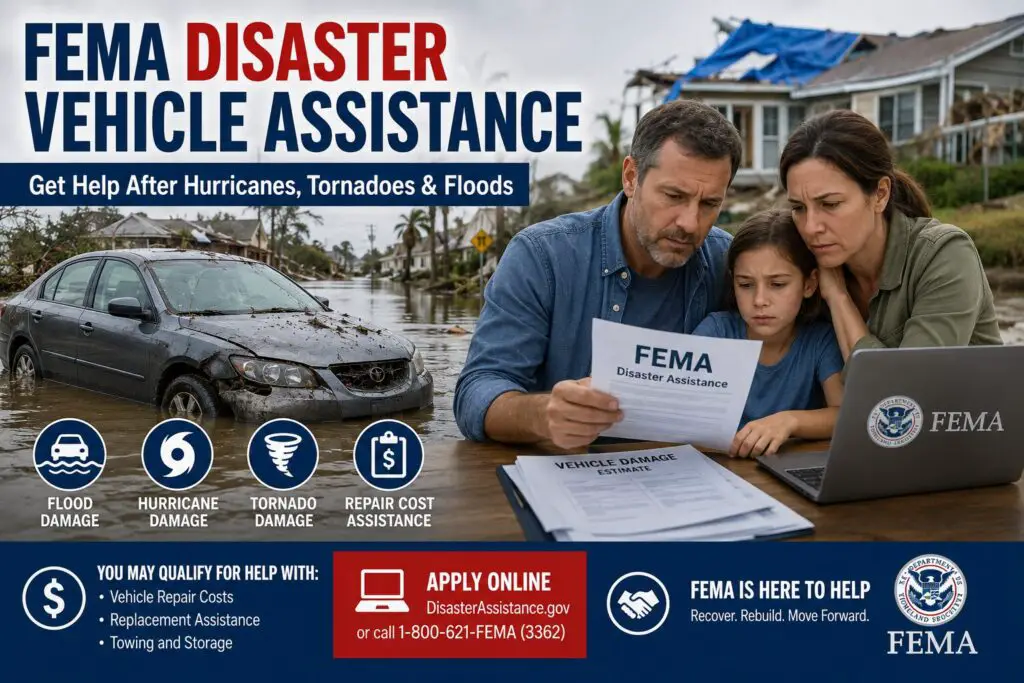
When a hurricane, tornado, or flood destroys your car, the damage feels overwhelming. But here’s what most disaster survivors don’t know: FEMA can help pay to repair or replace your vehicle. You don’t have to replace a damaged car out-of-pocket. Here’s the complete guide on what FEMA covers, who qualifies, and how to apply for disaster vehicle assistance before the deadline passes.
⚡ Quick AnswerIf your car was damaged in a Presidentially-declared disaster (hurricane, tornado, flood, etc.), you may qualify for FEMA Individual Assistance to repair or replace it. FEMA covers damages insurance doesn’t cover and typically doesn’t require repayment. You must apply within 60 days of the disaster declaration. Vehicle must be damaged (not operable or unsafe to drive), owned by you, and have valid registration/insurance at time of disaster. Apply at DisasterAssistance.gov or call 1-800-621-3362.
What Is FEMA Disaster Vehicle Assistance?
FEMA’s Individual Assistance (IA) program provides grants to disaster survivors for essential needs not covered by insurance or other sources. This includes vehicle repair or replacement when your car is damaged by a federally-declared disaster.
Key things to understand:
- It’s a grant, not a loan — You don’t repay FEMA disaster assistance
- It fills insurance gaps — FEMA can’t duplicate insurance payments, but if you’re underinsured, FEMA helps cover the rest
- It’s for essential use — Vehicle must be necessary for your household (job, medical care, school)
- Coverage varies — Depends on your specific damage, insurance, income, and state
- Time limit exists — Usually 60 days from disaster declaration to apply
FEMA is NOT insurance. It’s emergency relief to help you recover, not to fully replace your losses.
In 2026 alone, FEMA processed disaster vehicle assistance for thousands of families after hurricanes Milton, Helene, Beryl, and multiple tornado events. Billions in disaster aid has been distributed. If your area is declared a disaster area, you’re eligible to apply.
Do You Qualify? (6 Key Requirements)
To qualify for FEMA vehicle assistance, you must meet ALL of these requirements:
| Requirement | What It Means | How to Prove It |
|---|---|---|
| Presidentially-Declared Disaster | Your area must be in a disaster declaration (DR number) issued by the President | Check FEMA.gov/Disaster — find your county/state. If declared, you can apply |
| Vehicle Damaged During Disaster | Your car must have been damaged directly by the disaster (hurricane, flood, tornado, etc.) AFTER the disaster date | Photos of damage, mechanic statement, insurance adjuster report, FEMA housing inspector assessment |
| Vehicle Not Operable/Unsafe | Car must be unable to run safely. Cosmetic damage alone doesn’t qualify | Mechanic estimate showing structural/mechanical damage (not paint, dents, scratches) |
| You Own the Vehicle | Vehicle registration and title must be in your name at time of disaster | Valid registration (dated before disaster), title document, proof of ownership |
| Vehicle Was Insured | Vehicle must have had minimum liability insurance required by your state at time of disaster | Insurance policy declaration page (even if no full coverage), or statement showing liability at time of damage |
| No Other Vehicle Available | You should have no other working vehicle. If you do, you must show essential need for two | Statement explaining why you need both vehicles (separate work locations, medical care, school runs) |
You must apply within 60 days of the disaster declaration date. After 60 days, you lose eligibility. If you’re reading this days after a disaster, apply immediately. Don’t delay. Call 1-800-621-3362 or visit DisasterAssistance.gov TODAY.
What Fema Vehicle Damage IS Covered
FEMA covers damage that affects the safety and operation of your vehicle:
- Water/flood damage — Engine, transmission, electrical systems damaged by standing water
- Structural damage — Bent frame, crushed panels, doors that don’t work
- Broken/damaged glass — Windows, windshields damaged by storm debris
- Engine damage — From debris impact or water intrusion
- Transmission/drivetrain — Damaged by water or impact
- Electrical system — Shorting, malfunction from water damage
- Suspension/steering — Damage that makes car unsafe to drive
- Partial repairs needed to make car safe — E.g., engine replacement when other parts are salvageable
- Complete replacement — When repair cost exceeds car’s value or car is totaled
What FEMA Vehicle Damage IS NOT Covered
FEMA does NOT cover:
- Cosmetic damage — Dents, scratches, paint chips, minor dings (not affecting safety)
- Luxury upgrades — Custom rims, stereo systems, modifications, enhanced interiors
- Routine maintenance — Oil changes, filters, brake pads (unless storm-damaged)
- Pre-disaster problems — Damage that existed before the storm
- Non-disaster losses — Theft, mechanical failure unrelated to disaster
- Second vehicles — Usually limited to one vehicle unless you prove essential need
- Vehicles that didn’t work before — Car must have been operable before the disaster
Ask yourself: “Does this damage prevent the car from operating safely?” If YES → likely covered. If NO (just cosmetic) → not covered.
How Much FEMA Will Pay
FEMA doesn’t publish exact dollar limits, but here’s how the process works:
- Insurance first — Your insurance company pays what they’re supposed to cover
- FEMA fills the gap — FEMA covers reasonable repair/replacement costs NOT paid by insurance
- Reasonable cost limits apply — FEMA won’t pay for luxury repairs. They pay market-rate replacement
- Income affects assistance — Higher income may receive lower assistance or none (varies by state)
- Multiple vehicles — Assistance usually limited to ONE vehicle (essential vehicle only)
Real examples:
- $15,000 car with $8,000 damage, full insurance coverage: Insurance pays $8,000. FEMA pays $0 (insurance covered it)
- $15,000 car with $10,000 damage, $5,000 insurance: Insurance pays $5,000. FEMA may cover up to $5,000 of the remaining damage
- $12,000 car totaled, $3,000 insurance payout: Insurance pays $3,000. FEMA may cover portion of remaining loss depending on your income and need
- Uninsured car with $8,000 damage: FEMA may cover eligible portion depending on income and state policy
FEMA assistance is designed to help, not fully replace all losses. You typically won’t receive 100% of damage costs. The goal is to get you back to functional transportation, not luxury restoration.
How to Apply for FEMA Vehicle Assistance (Step by Step)
- Verify disaster declaration — Go to FEMA.gov/Disaster and check if your county is declared. Look for your state and find the DR (Disaster Recovery) number
- Document your damage — Take photos/videos of damaged vehicle from multiple angles. Get mechanic estimate showing what’s broken and cost to fix
- Register with FEMA — Visit DisasterAssistance.gov, call 1-800-621-3362, or use FEMA mobile app. Provide: address, phone, email
- Complete application form — Describe vehicle damage, provide insurance info, list all your vehicles (damaged and undamaged), provide household income information
- Submit documentation — Vehicle registration, valid ID, insurance policy, mechanic estimate(s), photo of damage, proof of vehicle ownership
- FEMA reviews your case — May take 1-4 weeks. FEMA may contact you for more info or send inspector to assess damage
- Get approval letter — If approved, FEMA sends eligibility letter with approved amount and payment details
- Get repairs/replacement done — Use approved mechanic or dealer. Keep all receipts
- Submit receipts to FEMA — Send proof of repair/replacement completion. FEMA processes and disburses funds
Apply IMMEDIATELY. Don’t wait 30 days thinking about it. The 60-day deadline approaches fast. Register with FEMA today (takes 5 minutes), then gather documentation. Better to apply early than miss the deadline.
Frequently Asked Questions
Red Flags: Scams to Avoid During Disasters
After disasters, scammers prey on vulnerable people. Here’s what to watch for:
- Unsolicited FEMA calls/emails: FEMA doesn’t call you first — they respond to YOUR application. Hang up and call 1-800-621-3362 yourself
- “Grant money” upfront offers: Legitimate FEMA doesn’t require you to pay money to receive grants. If someone asks for payment, it’s a scam
- Social media “claim your disaster money”: Ignore private messages on Facebook/TikTok claiming you’ve been selected for grants. Real FEMA processes happen through official channels
- Unlicensed “FEMA contractors”: Only work with licensed mechanics. Verify contractor licenses through your state
- Too-good-to-be-true buyout offers: Scammers may lowball your damaged car. Don’t sell to unknown buyers. Let FEMA help or use insurance payout
Apply ONLY through: DisasterAssistance.gov | 1-800-621-3362 | FEMA Mobile App | In-person Disaster Recovery Centers. These are the only official FEMA channels.
If You’re SBA Loan Eligible Instead
If FEMA denies your grant application, you may still qualify for an SBA (Small Business Administration) low-interest disaster loan.
- Homeowners & renters: Can borrow up to $40,000 for personal property damage (including vehicles)
- Interest rate: Current SBA disaster rate is typically 3-4% (historically low)
- Repayment: Usually 30 years, affordable monthly payments
- How it works: FEMA automatically refers you to SBA if you don’t qualify for FEMA grants
- If you can’t afford the loan: SBA determines you can’t pay → you get referred back to FEMA for additional grant assistance
Ask FEMA about SBA options if your grant is denied or insufficient.
Action Plan: Do This NOW (If In a Disaster Area)
✓ Verify disaster declaration: Go to FEMA.gov/Disaster and search for your county. Note the DR number.
✓ Register with FEMA TODAY: DisasterAssistance.gov, app, or call 1-800-621-3362. Takes 5 minutes.
✓ Document damage: Take photos/videos of car from multiple angles. Don’t discard parts — show damage clearly.
✓ Get repair estimate: Call 2-3 mechanics and get written estimates for repair. They should state “storm damage”.
✓ Gather documents: Vehicle registration, valid ID, insurance policy, mechanic estimates, photos.
✓ Submit to FEMA: Complete application with all documentation within 60 days of disaster date.
✓ Don’t miss deadline: 60 days goes fast. Apply ASAP, even if documentation isn’t perfect. You can submit additional docs later.
Official Resources
- DisasterAssistance.gov — Apply for FEMA Assistance
- FEMA.gov/Disaster — Find Your Disaster Declaration
- FEMA Helpline: 1-800-621-3362 (6 AM – 11 PM, language support available)
- Find Disaster Recovery Centers Near You
- FEMA Individual Assistance Program Guide
- SBA Disaster Loans — If Grant Denied