
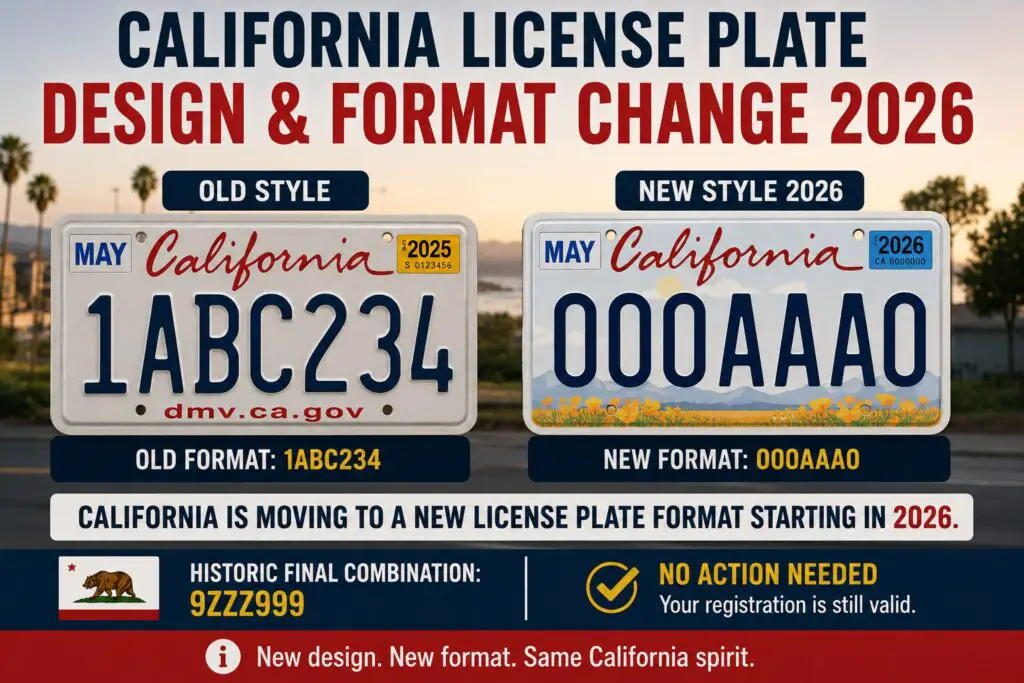
For the first time in nearly 50 years, California is changing its iconic license plate format. After 45 years of the familiar “1ABC234” design, the state has officially run out of plate combinations and is rolling out a brand new format in 2026. If you’re registering a new vehicle in California this year or curious about what the change means, here’s everything you need to know.
⚡ Quick AnswerStarting March 2026, new California vehicle registrations will receive plates in a new format: three numbers, three letters, one number (like 000AAA0), instead of the current one number, three letters, three numbers (1ABC234). This change only affects NEW vehicle registrations — your existing plate remains valid if you already have one. Only passenger vehicles are affected; commercial trucks, motorcycles, trailers, and specialty plates stay the same. The change happened because California ran out of available combinations in the old format.
Why California Changed License Plate Format in 2026
California ran out of license plate combinations. It’s as simple as that.
Here’s the timeline:
- 1980: California introduced the current format: 1 number + 3 letters + 3 numbers (1AAA000 was the first plate)
- 2026: The system approaches the final combination: 9ZZZ999
- March 2026: California officially runs out and switches to the new format: 000AAA0
The math is simple:
- Old format (1ABC234): 9 × 26³ × 10³ = approximately 158 million possible combinations
- California’s population and vehicle registrations grew faster than anticipated in 1980
- By 2026, after 45 years of growth, the state exhausted nearly all available combinations
Why not recycle old plates? The California DMV considered recycling retired plates but decided against it. Recycling creates confusion with registration databases and law enforcement records. A completely new format is cleaner and more efficient.
Before 1980, California used a different format: 3 numbers + 3 letters (ABC123). The 1980 change was the FIRST format change in decades. Now, 45 years later, we’re seeing only the SECOND major change in California’s modern vehicle registration history. This makes 2026 a genuinely historic moment for California drivers.
Old Format vs New Format: Side-by-Side
| Feature | Old Format (1980-2026) | New Format (2026+) |
|---|---|---|
| Example Plate | 1ABC234 | 000AAA0 |
| First Position | Number (1-9) | Number (0-9) |
| Positions 2-4 | Letters (A-Z) | Letters (A-Z) |
| Positions 5-7 | Numbers (0-9) | Letters (A-Z) |
| Position 8 | N/A | Number (0-9) |
| Pattern | Number-Letters-Numbers | Numbers-Letters-Number |
| Total Characters | 7 | 7 |
| Possible Combinations | ~158 million | ~162 million+ |
The new format is essentially a “mirror image” of the old format — all the numbers and letters are flipped! This makes it visually distinct while maintaining the same 7-character structure.
What Vehicles Are Affected?
| Vehicle Type | New Format Applies? | Notes |
|---|---|---|
| Passenger Vehicles | ✓ YES | Cars, sedans, SUVs, trucks under certain weights — gets new format |
| Commercial Trucks | ✗ NO | Remain on commercial plate system |
| Motorcycles | ✗ NO | Keep motorcycle-specific plate format |
| Trailers | ✗ NO | Remain on trailer plate system |
| Specialty Plates | ✗ NO | Vanity plates, veteran plates, etc. may keep existing format or transition separately |
| Personalized Plates | ? VARIES | Check with DMV for current personalized plate format rules |
| Existing Plates | ✗ NO CHANGE | If you already have 1ABC234, you keep it. Only NEW registrations get 000AAA0 |
You do NOT need to replace your existing California license plate. If you got your plate anytime before March 2026, keep it — it’s valid for the life of your vehicle (unless it gets damaged/unreadable). The new format only applies to NEW vehicle registrations starting in March 2026.
When Does the New Format Start?
The new 000AAA0 format officially began in March 2026.
Timeline:
- Before March 2026: All new registrations received plates in the old 1ABC234 format
- March 2026: California DMV switched to 000AAA0 format for all new passenger vehicle registrations
- First plate issued: 000AAA1 (or similar, depending on regional processing)
- Ongoing: All new registrations from March 2026 forward receive the new format
Regional rollout: The change may have rolled out at slightly different times across northern California, central California, and southern California based on DMV processing centers. But all regions are now using the new format.
How to Tell Old vs. New Plates
It’s simple to spot the difference on the road:
If the plate looks like: 1ABC234, 7XYZ890, 5QRS123 → It’s using the old 1980 format. First character is always a single number.
If the plate looks like: 000AAA0, 123XYZ5, 456DEF9 → It’s using the new 2026 format. First three characters are always numbers.
Rule of thumb: If the first character is a single number followed by three letters (like “3ABC”), it’s OLD format. If it starts with multiple numbers before the letters (like “123ABC” or “000ABC”), it’s NEW format.
What You Need to Do (If Registering a New Vehicle)
If you’re registering a new vehicle in California in 2026, you’ll automatically receive the new format plate. You don’t need to do anything special.
- Go to the DMV or use an online registration service as normal
- Complete your vehicle registration application following standard DMV procedures
- Pay your registration fees
- Receive your plate in the new 000AAA0 format — it will be assigned automatically
- Install your plate on your vehicle following California law (front and back)
Important: You cannot request a specific new format plate number (unless you’re buying a personalized/vanity plate). The DMV assigns your plate sequentially from the available pool.
Frequently Asked Questions
A Piece of California History
The old 1ABC234 format has been part of California culture for 45 years. If you’ve driven in California during any part of that time, you’ve seen millions of these plates. They’re iconic.
Some California drivers collected or remembered specific notable plates. The format appeared in countless photos, movies, TV shows, and memories. For many Californians, this change feels like the end of an era.
But it’s also a sign of growth. California’s license plate format lasted longer than nearly any other state’s. The fact that the state needed a format change shows just how much California has grown since 1980.
Some people sought out 9ZZZ999 in anticipation, hoping to be the holder of the final “classic” California plate. Collectors and enthusiasts tracked the DMV’s progress through the 9-series plates. Whoever received 9ZZZ999 became part of California history!
Official Sources
- California Department of Motor Vehicles (DMV) — Official Website
- DMV Vehicle Registration Information
- California DMV Local Offices (find yours at dmv.ca.gov)
- California Highway Patrol for vehicle/plate verification


