Last updated: November 14, 2026
Quick answer
If money is tight, the best Black Friday (November 27, 2026) car-care buys are cheap basics that prevent breakdowns or help you diagnose a problem: a tire pressure gauge and inflator, a portable jump starter and an OBD2 code reader. But bigger savings usually come from free or low-cost repair help: free safety-recall repairs, 211, your TANF or benefits caseworker and local charities. We do not list prices or specific sales here; compare the total cost yourself before you buy.
Consumer Auto is an independent research site. We are not a government agency, a repair shop or a store, and this guide is general information, not legal, financial or mechanical advice.
A broken car can mean a missed shift or a lost job, so Black Friday ads for car-care gear are tempting. Not every sale is a good buy, though, and some tools do nothing for you unless you know how to use them. This guide covers the basic items that are worth considering, how to avoid wasting money, and the free and low-cost repair help you should check before you pay for anything.
Before You Buy Anything on Black Friday
- Start with the problem, not the sale. Ask what actually keeps your car from running: a weak battery, low tires, a check-engine light or a repair you cannot afford. Buy only what fixes or prevents that problem.
- Do not trust a “was” price. Check the same model at several stores in the days before and after. A crossed-out price does not prove a real discount.
- Check the return policy and the seller. Buy from stores you recognize and keep the receipt in case the item does not fit your car.
- Make sure it fits your vehicle. Compatibility, engine size and model year matter, especially for jump starters and code readers. Check your owner’s manual.
- Skip anything you cannot explain a use for. A gadget that sits in the trunk is not savings.
Basic Car-Care Items Worth Considering
1. Tire pressure gauge and portable inflator
Tires are one of the cheapest things to look after. NHTSA says to check the pressure of all tires, including the spare, at least once a month, when the tires are “cold,” meaning the car has not been driven for at least three hours. The correct pressure is on the Tire and Loading Information Label (usually on the driver’s door edge or door jamb) or in your owner’s manual. Newer cars have a tire pressure monitoring system, but NHTSA says it only warns when a tire is significantly underinflated, so a monthly check is still worth doing. NHTSA also says tires should be replaced when the tread is worn down to 2/32 of an inch. A simple gauge matters more than an expensive inflator. For help with a flat, see our guide to changing a tire.
2. Portable jump starter
A portable jump starter can restart a car with a dead battery without another vehicle or cables. Check that it is rated for your engine size, follow your owner’s manual and the product’s instructions, and keep it charged. A jump start fixes a dead battery for now but does not fix the reason the battery died. If the car will not start again, the battery or charging system may need to be tested.
3. OBD2 code reader
EPA requires on-board diagnostics on 1996-and-newer cars and light trucks, which use a standard 16-pin connector, usually under the dashboard on the driver’s side. A code reader plugs in and shows the stored trouble codes behind a check-engine light. One caution: a code points to a system or a symptom, not always to the broken part, so do not buy parts by guessing from a code alone. Search the code for your exact vehicle and ask a mechanic if you are unsure. Many auto parts stores offer free code reading; availability varies, so call first. Cars older than 1996 do not have OBD-II, so a code reader will not help.
4. Dash camera (optional)
A dash cam does not repair anything, so skip it if your budget is tight. If you want one, check your state’s rules on mounting devices on the windshield and on recording audio. See our dash camera installation guide.
Free and Low-Cost Repair Help: Check These First
For most low-income drivers, these steps can save more than any sale. Availability depends on where you live and on current funding.
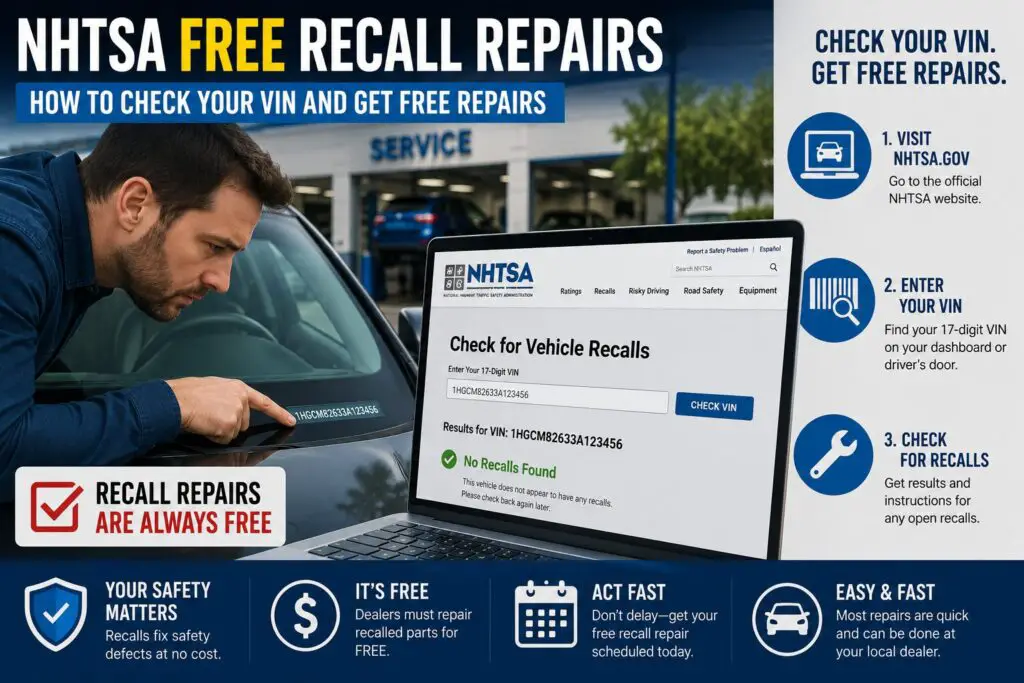
- Check for open safety recalls. Enter your 17-character VIN at NHTSA.gov/recalls. If there is an open recall, contact your manufacturer’s local dealer to schedule the repair, which is free for safety recalls.
- Call 211. 211 is a free, confidential service that can point you to local help. Some communities have programs for car repairs, gas, bus passes or rides to work. What is available varies by community.
- Ask your caseworker about TANF supportive services. If you receive TANF, ask whether transportation or vehicle repair help is available. See our TANF car repair assistance guide. Approval is usually required before you pay for the repair.
- Read your state’s guide. Programs differ widely:
- Pennsylvania welfare car voucher guide (TANF special allowances)
- Ohio car voucher guide (county PRC plans)
- Michigan DHS car voucher guide
- California car voucher guide (including smog-related repair help)
- DHS car voucher guide for other states
- Try charities and churches. Some local organizations help with repairs. Funds are limited and rules vary, so call first. See our guides on churches that help with car repairs, Salvation Army car repair help and auto repair grants for low-income families.
- Get a written estimate and a second opinion. Before any repair, ask for a written estimate, ask which parts are urgent and which can wait, and compare at least one other shop. Many help programs also require an estimate.
If a Shop Advertises a Black Friday Repair Deal
Some shops and tire retailers may run holiday promotions, but we cannot verify any specific offer. Before you pay, ask what the deal covers, what is excluded, whether it needs a minimum purchase and what the final price will be with parts, labor, taxes and fees. A coupon on an oil change does not help if the visit turns into a long list of add-on services you did not need. Say no to work you did not agree to.
Cold-Weather Basics That Cost Little
- Check tire pressure and tread monthly.
- Know where your spare, jack and lug wrench are.
- Keep a jump starter or cables in the car, with instructions.
- Do not ignore a check-engine light or a slow-cranking engine. Find out the cause before it becomes a bigger repair.
Frequently Asked Questions
Is Black Friday a good time to buy an OBD2 scanner or jump starter?
It can be, but only if the price is truly lower than usual and the item fits your car. Compare the same model across stores and check the return policy. We do not list specific deals or prices because they change quickly.
Do I need to buy an OBD2 reader if a store reads codes for free?
Not necessarily. Many auto parts stores offer free code reading, but availability varies, so call first. Owning a reader is mostly useful if you check your car often or want to see the code before visiting a shop.
Can a jump starter replace a new battery?
No. It gets a car with a dead battery going, but if the battery is worn out or the charging system has a problem, the car may not start again. Have the battery tested.
How often should I check my tire pressure?
NHTSA says at least once a month, when the tires are cold, using the pressure on your vehicle’s label or in the owner’s manual.
Where can I find free car repair help if my income is low?
Start with open safety recalls, 211, your caseworker if you receive TANF or other benefits, and local charities. Our auto repair grants guide and state guides above explain where to ask.
Does a car voucher cover repairs?
It depends on the state and program. Some state or county programs help with repairs, usually with approval first and a limit on the amount. See the state guides above.
Is buying a car on Black Friday a better idea than repairing mine?
Not always. Compare the cost of the repair with the full cost of another vehicle (price, loan interest, insurance and its own repairs). Our Black Friday car buying guide for low-income and bad-credit buyers explains the dealer traps to avoid.
Bottom Line
Do not let a sale decide what you buy. Fix the problem you actually have, spend on cheap basics that prevent breakdowns and ask for free help first: recalls, 211, your caseworker and local charities. Then compare the total cost of anything you decide to buy.
Sources
- NHTSA: TireWise: tire pressure, tread and TPMS guidance
- NHTSA: Check for recalls by VIN
- EPA: Do you drive a 1996 or newer car or light truck? (on-board diagnostics, OBD-II)
- United Way: 211 community help line